Quick Answer
The best way to get from Haneda Airport to Ueno is the Keikyu Line to Shinagawa + JR Yamanote Line to Ueno (35-45 minutes, 590¥/$3.95). For Japan Rail Pass holders: Tokyo Monorail to Hamamatsucho + JR Yamanote Line to Ueno (40-50 minutes, 660¥/$4.40, covered by pass). For convenience with luggage: Limousine Bus to Ueno Station (50-80 minutes, 1,200¥/$8.05). For late night arrivals (after midnight): Taxi (40-60 minutes, 8,000-12,000¥/$54-80). The internet often says "Keikyu+JR is the best option" but I don't actually recommend the Keikyu+JR transfer during Tokyo's rush hour (7:30-9:30 AM, especially Monday mornings) if you have more than carry-on luggage - Shinagawa Station is massive and crowded, and the Yamanote Line is famously packed during commute hours.
How to Get from Haneda Airport to Ueno by Train
Tokyo Haneda Airport (HND) connects to Ueno via two main rail routes, both requiring one transfer. The Keikyu Line connects to the JR Yamanote Line at Shinagawa, while the Tokyo Monorail connects to the JR Yamanote Line at Hamamatsucho. Ueno is a major transportation hub with multiple stations: JR Ueno Station (Yamanote Line, Keihin-Tohoku Line), Keisei Ueno Station (for Skyliner to Narita), and Tokyo Metro Ueno Station (Ginza, Hibiya lines).
| Route | Train Lines | Travel Time | Cost | Best For |
|---|---|---|---|---|
| Keikyu → JR Yamanote to Ueno | Keikyu + JR Yamanote | 35-45 minutes | 590¥ ($3.95) | Most travelers, budget, speed |
| Monorail → JR Yamanote to Ueno | Tokyo Monorail + JR Yamanote | 40-50 minutes | 660¥ ($4.40) | Japan Rail Pass holders, less crowded transfer |
| Keikyu → Asakusa Line → Ueno | Keikyu + Toei Asakusa | 45-55 minutes | 590¥ ($3.95) | Avoiding JR crowds, subway preference |
| Keikyu → JR Keihin-Tohoku to Ueno | Keikyu + JR Keihin-Tohoku | 40-50 minutes | 590¥ ($3.95) | Alternative to crowded Yamanote |
A Common Example of a Real-Life Mistake with Keikyu+JR
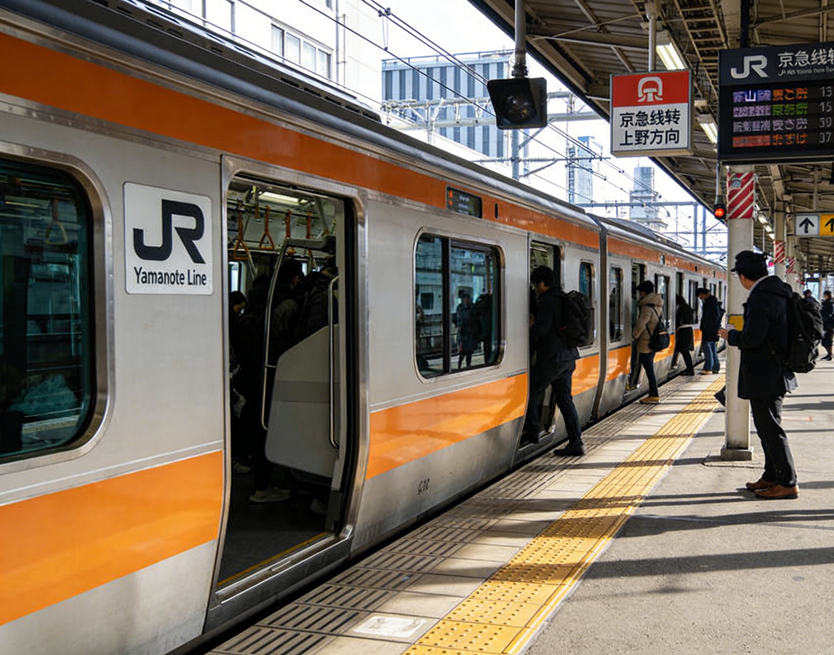
You arrive at Haneda at 8:20 AM on Monday with two large suitcases. You take Keikyu Line to Shinagawa (12 minutes). Shinagawa Station is packed with Tokyo's morning commute. You wait 8 minutes to transfer through crowded corridors. Three packed Yamanote trains go by before you can squeeze on with your luggage. The 35-minute journey becomes 60 minutes. A Limousine Bus would have cost 1,200¥ ($8.05) vs 590¥ ($3.95) but offered a seated, less stressful ride. This happens daily to tourists who underestimate Tokyo's rush hour intensity at major transfer stations.
Keikyu Line to Shinagawa + JR Yamanote to Ueno (Most Popular)
The Keikyu Line takes 12 minutes from Haneda International Terminal to Shinagawa Station. Cost: 300¥ ($2.00). At Shinagawa, transfer to JR Yamanote Line (clockwise direction) for 6 stops to Ueno Station (15 minutes, 170¥/$1.15). Ueno is on the Yamanote Line's northeastern arc. Total: 35-45 minutes, 590¥ ($3.95). This route is not covered by Japan Rail Pass (Keikyu is private railway). Frequency: Keikyu every 5-10 minutes, Yamanote every 3-5 minutes.
Tokyo Monorail to Hamamatsucho + JR Yamanote to Ueno (JR Pass Option)
The Tokyo Monorail takes 20 minutes from Haneda to Hamamatsucho Station. Cost: 490¥ ($3.30). At Hamamatsucho, transfer to JR Yamanote Line (clockwise) for 8 stops to Ueno (20 minutes, 170¥/$1.15). Total: 40-50 minutes, 660¥ ($4.40). This route is covered by Japan Rail Pass. Some travelers prefer this as Hamamatsucho is smaller than Shinagawa, potentially easier for transfers.
Why the Internet is Partially Wrong About Keikyu+JR Being Always Best
The internet consistently recommends "Keikyu+JR is the best option from Haneda to Ueno." This is only partially true. Keikyu+JR is good for: Budget travelers, those without JR Pass, traveling outside rush hours, minimal luggage. Keikyu+JR is bad for: Multiple/large suitcases during rush hour, mobility issues (long transfers at Shinagawa), Japan Rail Pass holders (not covered), those intimidated by massive stations. Many travel blogs recommend this route without the crucial caveat about Shinagawa Station's scale and crowds during peak times.
Keikyu Line to Asakusa + Subway to Ueno (Alternative Route)
The Keikyu Line takes 45-50 minutes directly to Asakusa Station (630¥/$4.20). At Asakusa, transfer to Tokyo Metro Ginza Line for 2 stops to Ueno (5 minutes, 180¥/$1.20). Total: 50-60 minutes, 810¥ ($5.40). This route is longer and more expensive but avoids JR crowds. Useful if your hotel is near Asakusa or you're continuing beyond Ueno. Not recommended for most travelers to Ueno.
Limousine Buses from Haneda Airport to Ueno
For direct service to Ueno Station without transfers, Limousine Buses (Airport Limousine) offer a comfortable alternative. Buses depart from all Haneda terminals and stop at Ueno Station. Travel time is 50-80 minutes depending on traffic. Cost is 1,200¥ ($8.05) per person. Buses have luggage compartments and are a good option if your hotel is near Ueno Station.
Limousine Bus Routes to Ueno Area
Key bus stops in Ueno:
- Ueno Station (Hirokoji Exit): Main stop, 1-minute walk to JR Ueno Station
- Ueno Station (Shinobazu Exit): Some buses, near Ueno Park
- Some hotels in Ueno: Check if your hotel has direct service
Frequency: Every 20-40 minutes. Operating hours: Approximately 6:00-23:00. Night buses: Limited service, higher fare.
A Common Example of a Real-Life Mistake with Limousine Buses
You take the Limousine Bus to Ueno at 5:00 PM on Friday. The bus gets stuck in Tokyo's infamous Friday evening traffic on the Shuto Expressway. The 50-minute ride becomes 90 minutes. You're exhausted and miss your 7:00 PM dinner reservation at a restaurant in Ueno. Meanwhile, the Keikyu+JR would have taken 45 minutes regardless of traffic. This happens when travelers don't consider that airport buses use the same congested roads as taxis, especially during Tokyo's notorious evening rush hour.
When Limousine Buses Make Sense (And When They Don't)
Limousine Buses are good for: Hotels near Ueno Station, avoiding train station stairs with luggage, heavy rain/snow, comfortable seated travel, groups, travelers with mobility issues. Limousine Buses are bad for: Rush hour travel (same traffic as cars), tight schedules, budget travelers, late night (limited service), hotels in northern Ueno far from station. The internet rarely mentions that Ueno Station has multiple exits spread over a large area - the bus stop is convenient for the Hirokoji exit side but less so for the park side.
Night Buses and Alternative Bus Services
Night bus services are limited. The Access Narita bus between airports runs 24/7 but doesn't serve Ueno directly. Some highway buses might have late services but require transfers. For late night arrivals, taxi is usually the only practical option to reach Ueno directly.
Taxis & Private Transfers from Haneda Airport to Ueno
Taxis from Haneda Airport to Ueno
Taking a taxi from Haneda Airport to Ueno offers door-to-door convenience. The distance is approximately 25km, with travel time of 40-60 minutes normally, 60-90 minutes during rush hour. Taxi cost is approximately 8,000-12,000¥ ($54-80) including tolls (1,000-1,500¥) and potential night surcharge. Fixed fare taxis are available: 8,000¥ ($54) to central Tokyo (including Ueno) for up to 4 passengers. Official taxis are available at designated taxi stands outside all terminals.
Private Transfers & Hire Cars
Private transfer services can be pre-booked online for approximately 10,000-15,000¥ ($67-100) for a standard car. Hire cars with driver are also available. Services include meet-and-greet, English-speaking driver, fixed rates. Good for: Business travelers, groups, families with children, special occasions. Luxury options available at higher prices. Useful for hotels in Ueno's narrow side streets.
Is a Taxi Worth It from Haneda to Ueno?
For 3-4 people: Absolutely yes (split 8,000-12,000¥ = 2,000-4,000¥/$13.50-27 each vs 590-1,200¥ transport each). For solo travelers: Rarely (8,000-12,000¥/$54-80 vs 590-1,200¥/$3.95-8.05). For late night arrivals: Often necessary as last trains are around midnight. For families with kids: Usually worth it for convenience. During rush hour: Taxi is slower than trains but more comfortable with luggage. The internet warns about taxi costs, but for groups going to Ueno's less accessible areas, it can be the most practical option.
A Common Example of a Real-Life Mistake with Taxis
You take a taxi at 5:00 PM on Friday. The driver takes the Shuto Expressway, which is jammed. The 40-minute ride becomes 85 minutes, cost 11,500¥ ($77). Had you taken Keikyu+JR, it would have been 45 minutes and 590¥ ($3.95). You paid 10,910¥ ($73) more and took 40 minutes longer. Lesson: Friday evenings 4-8 PM, trains are faster and massively cheaper despite potential crowding.
Haneda to Ueno Routes & All Stops
Tokyo Haneda Airport is located 25km south of Ueno. The map below shows routes from Haneda Airport to Ueno. Trains follow dedicated rail lines, while road transport uses the Shuto Expressway and surface streets through central Tokyo.
View the route on Google Maps: View route from Haneda Airport to Ueno on Google Maps
Keikyu Line + JR Yamanote: Complete Route
Keikyu Line from Haneda to Shinagawa stops at:
- Haneda Airport Terminal 3 (International)
- Haneda Airport Terminal 1, 2
- Anamori-inari
- Tenkubashi
- Keikyu Kamata
- Zoshiki
- Rokugodote
- Keikyu Kawasaki
- Hatcho-nawate
- Tsuji
- Shimo-kojiya
- Keikyu Hatanodai
- Keikyu Samezu
- Heiwajima
- Otorii
- Keikyu Omori
- Ume Yashiki
- Shinagawa (transfer to JR Yamanote Line)
JR Yamanote Line from Shinagawa to Ueno (clockwise):
- Shinagawa (start)
- Osaki
- Gotanda
- Meguro
- Ebisu
- Shibuya
- Harajuku
- Yoyogi
- Shinjuku
- Shin-Okubo
- Takadanobaba
- Mejiro
- Ikebukuro
- Otsuka
- Sugamo
- Komagome
- Tabata
- Nippori
- Nishi-Nippori
- Uguisudani
- Ueno (end)
- Okachimachi (if you continue)
Tokyo Monorail + JR Yamanote: Complete Route
Tokyo Monorail from Haneda to Hamamatsucho stops at:
- Haneda Airport Terminal 3 (International)
- Haneda Airport Terminal 1
- Haneda Airport Terminal 2
- Tenkubashi
- Seibijo
- Showajima
- Ryutsu Center
- Terminal 2 (again, some trains)
- Hamamatsucho (transfer to JR Yamanote Line)
JR Yamanote Line from Hamamatsucho to Ueno (clockwise):
- Hamamatsucho (start)
- Tamachi
- Shinagawa
- Osaki
- Gotanda
- Meguro
- Ebisu
- Shibuya
- Harajuku
- Yoyogi
- Shinjuku
- Shin-Okubo
- Takadanobaba
- Mejiro
- Ikebukuro
- Otsuka
- Sugamo
- Komagome
- Tabata
- Nippori
- Nishi-Nippori
- Uguisudani
- Ueno (end)
Haneda to Ueno: Ticketing & Costs Comparison
| Transport Option | Total Travel Time | Approximate Cost | Best For | Worst For |
|---|---|---|---|---|
| Keikyu + JR Yamanote to Ueno | 35-45 minutes | 590¥ ($3.95) | Most travelers, budget, speed | Rush hour with luggage, JR Pass holders, mobility issues |
| Tokyo Monorail + JR to Ueno | 40-50 minutes | 660¥ ($4.40) | JR Pass holders, less crowded transfer | Budget travelers, those without JR Pass |
| Limousine Bus to Ueno Station | 50-80 minutes | 1,200¥ ($8.05) | Hotel near station, heavy luggage, comfort | Rush hour, budget, tight schedules |
| Taxi (metered) | 40-90 minutes | 8,000-12,000¥ ($54-80) | Groups 3-4, late night, heavy luggage | Solo budget travelers, rush hour |
| Fixed Fare Taxi | 40-90 minutes | 8,000¥ ($54) for 4 people | Groups, predictable pricing | Solo travelers |
| Private Transfer | 40-90 minutes | 10,000-15,000¥ ($67-100) | Business, luxury, families, pre-arranged | Budget travelers |
IC Cards (Suica, PASMO, ICOCA) for Tokyo Transport
IC Cards are rechargeable smart cards used for all Tokyo transport:
- Suica: JR East card, available at Haneda JR machines
- PASMO: Private railway card, available at Haneda Keikyu machines
- Welcome Suica: For tourists, 28-day validity, no deposit refund
- Cost: 500¥ deposit + credit loaded (except Welcome Suica)
- Where to buy: Ticket machines at Haneda stations, airport convenience stores
- Use for: Trains, subways, buses, convenience stores, vending machines
Single tickets are also available but less convenient. Japan Rail Pass covers JR lines (Monorail, Yamanote) but not Keikyu Line.
Tokyo Reality: Crowds, Luggage & Station Complexity
Getting from Haneda Airport to Ueno involves navigating some of Tokyo's most crowded train lines and complex stations. Your experience depends on: 1) Time of day and day of week (Monday mornings are worst for crowds), 2) Luggage type and amount (wheeled suitcases on packed trains vs car trunks), 3) Your exact destination in Ueno (Ueno Station area vs Ueno Park area). First-time visitors are often shocked by: 1) The sheer scale of Shinagawa and Ueno Stations, 2) Multiple train companies with separate ticket gates (JR vs private railways), 3) Long walking distances within stations. Late night arrivals have limited options but taxis are reliable. Early morning departures require planning as first trains are 5:00-5:30 AM. Overall: pack light, know your exact hotel location and nearest station exit, and consider paying more for convenience if you have heavy bags or are in a group.
Practical Tips for Haneda to Ueno by Situation
- With large luggage/suitcases (2+ bags): Limousine Bus or taxi. Trains with large luggage during rush hour is nearly impossible.
- Family with kids/strollers: Taxi or private transfer. Tokyo trains with strollers during crowded times is extremely challenging.
- Late night arrival (after midnight): Taxi. Last trains around midnight, night buses limited.
- Early morning flight departure: First trains to Haneda 5:00-5:30 AM. For flights before 8:00 AM, taxi or airport hotel.
- Monday morning arrival (7:30-9:30 AM): Worst crowds of week. Consider Limousine Bus or wait at airport until 10:00 AM.
- Business traveler with carry-on only: Keikyu+JR is efficient. Taxi if company pays.
- Elderly/disabled travelers: Taxi or private transfer door-to-door. Tokyo stations have elevators but they can be hard to find.
- Group of 3-4 people: Taxi often cheaper per person than train/bus. Split cost.
- Rainy day arrival: Limousine Bus or taxi avoids getting wet. Train requires walking to/from stations.
- Hotel near Ueno Station (JR side): Any train route to Ueno Station.
- Hotel near Keisei Ueno Station: Train to Ueno then 5-minute walk or taxi.
- Hotel in Ueno Park area: Use Park Exit from JR Ueno Station.
- Hotel in northern Ueno (Iriya area): Consider taxi from station as it's a 15-20 minute walk.
- Japan Rail Pass holders: Use Tokyo Monorail+JR (covered). Keikyu Line not covered.
- Return to airport: From Ueno to Haneda, allow: Train 45-55 minutes + buffer, Limousine Bus 60-90 minutes + traffic buffer.
- Mobile apps: "Japan Travel" by Navitime, "Google Maps" for transit, "Japan Official Travel App".
- Payment methods: Trains: IC cards best, cash for single tickets. Buses: Cash or IC card. Taxi: Cash or credit card.
- Language tips: Have your destination written in Japanese. Most transport staff speak limited English.
- Tokyo rush hour (7:30-9:30 AM, 5:00-7:00 PM): Extremely crowded. Avoid trains with luggage if possible.
- Airport terminals: International flights use Terminal 3. Domestic use Terminals 1-2. Free shuttle buses connect terminals.
- Luggage forwarding services: Use Yamato Transport to send luggage to hotel (available at airport).
Common Haneda to Ueno Mistakes
The "Monday Morning Shinagawa Transfer" Crowd Error
You arrive at Haneda Monday at 8:15 AM. You take Keikyu Line to Shinagawa. The station is packed with commuters. You wait 10 minutes just to transfer through ticket gates. Three packed Yamanote trains pass completely full. You finally board the fourth, standing with luggage blocking the aisle. Total time: 60 minutes vs expected 40. A Limousine Bus would have been 70 minutes but seated. Lesson: Monday mornings, consider alternatives to Keikyu+JR.
The "Last Train" Timing Miscalculation
Your flight lands at 11:40 PM. You think you have time for last trains around midnight. Deplaning, immigration, baggage claim takes 35 minutes. You reach Keikyu platform at 12:15 AM. Last train left at 12:10 AM. Now you need a 10,000¥ ($67) taxi. Had you gone straight to taxi queue, you'd have paid the same but been at hotel sooner. Lesson: If landing after 11:30 PM, assume you won't make last trains. Go to taxi queue immediately.
The "Wrong Ueno Station Exit" Long Walk
Your hotel is near Ueno Park. You exit Ueno Station at the wrong exit (Hirokoji instead of Park Exit). What should be a 5-minute walk becomes 15 minutes with luggage through crowded streets. Had you researched exits, you'd have saved 10 minutes. Lesson: Ueno Station has 20+ exits. Know which exit is closest to your hotel.
The "We're 3, Train is Cheaper" Math Error
Three adults calculate: Train 590¥ each = 1,770¥ ($11.85). Taxi shows 9,000¥ ($60). They choose train. What they don't factor: 1) Hotel is 12-minute walk from station (with luggage), 2) Need taxi from station 1,200¥ ($8.05), 3) Total 2,970¥ ($19.90) + 20 minutes extra vs taxi direct 9,000¥ ($60). Taxi is 3x more but door-to-door. Lesson: Factor final door-to-door cost, time, and convenience.
The "IC Card vs Single Ticket" Confusion
You buy single tickets for Keikyu and JR separately. At Shinagawa, you exit Keikyu, find JR gates, buy new ticket. This takes 8 minutes in crowded station. With IC card, you'd just tap through. You miss a train. Lesson: Get IC card (Suica/PASMO) at airport. It's faster and calculates transfers automatically.
The "Limousine Bus During Rush Hour" Traffic Surprise
You take Limousine Bus at 5:00 PM Friday. Bus gets stuck in traffic - 85 minutes to Ueno. You're tired, miss your plans. Train would have been 45 minutes. Lesson: During Tokyo rush hour, trains are more reliable time-wise than road transport.
The "Japan Rail Pass Doesn't Cover Keikyu" Mistake
You have JR Pass, board Keikyu Line. At Shinagawa, you can't exit with JR Pass. You must pay 300¥ ($2.00) at fare adjustment machine. Lesson: JR Pass only covers JR lines. Keikyu is private railway. Have IC card or cash for non-JR transport.
Frequently Asked Questions: Haneda to Ueno
What is the best way to get from Haneda Airport to Ueno?
For most travelers: Keikyu Line to Shinagawa + JR Yamanote Line to Ueno (35-45 minutes, 590¥/$3.95). For Japan Rail Pass holders: Tokyo Monorail to Hamamatsucho + JR Yamanote Line to Ueno (40-50 minutes, 660¥/$4.40, covered by pass). For convenience with luggage: Limousine Bus to Ueno Station (50-80 minutes, 1,200¥/$8.05). The internet says Keikyu+JR is best, but I don't actually recommend it during Tokyo's rush hour with luggage - trains are packed and Shinagawa Station transfer is challenging.
Is there a direct train from Haneda Airport to Ueno?
NO direct train. Options: 1) Keikyu Line to Shinagawa + JR Yamanote Line to Ueno, 2) Tokyo Monorail to Hamamatsucho + JR Yamanote Line to Ueno, 3) Limousine Bus direct to Ueno Station. The internet sometimes confuses this with the Skyliner from Narita, but from Haneda there is no direct rail service to Ueno. You must transfer at least once. The Keikyu+JR combination is the most efficient rail route.
How long does it take from Haneda Airport to Ueno?
Keikyu + JR Yamanote: 35-45 minutes. Tokyo Monorail + JR Yamanote: 40-50 minutes. Limousine Bus: 50-80 minutes depending on traffic. Taxi: 40-60 minutes normally, 60-90 minutes during rush hour. During Tokyo's rush hour (7:30-9:30 AM, 5:00-7:00 PM), taxi/bus times can increase significantly. The distance is 25km (15.5 miles) but Tokyo traffic can be heavy. Late night with no traffic: 35-45 minutes by taxi.
What is the cheapest way from Haneda Airport to Ueno?
Keikyu Line to Shinagawa + JR Yamanote to Ueno: 590¥ ($3.95). Tokyo Monorail to Hamamatsucho + JR Yamanote to Ueno: 660¥ ($4.40). Many websites recommend Keikyu+JR as cheapest, and I agree for Ueno - it's 70¥ cheaper than the Monorail route. However, during rush hour, the Monorail route might be less crowded at Hamamatsucho than Keikyu at Shinagawa, so sometimes paying 70¥ more is worth it for a slightly easier transfer, especially with luggage.
Are taxis worth it from Haneda to Ueno?
For 3-4 people: Absolutely yes (split 8,000-12,000¥ = 2,000-4,000¥/$13.50-27 each vs 590-1,200¥ transport each). For solo travelers: Rarely (8,000-12,000¥/$54-80 vs 590-1,200¥/$3.95-8.05). For late night arrivals: Often necessary as last trains are around midnight. For families with kids: Usually worth it for convenience. Fixed fare taxis are available: 8,000¥ ($54) to central Tokyo (including Ueno) for up to 4 people. This can be good value for groups.
How do I get from Haneda Airport to my Ueno hotel with large luggage?
Option 1: Limousine Bus to Ueno Station (if your hotel is nearby) - most convenient with luggage. Option 2: Taxi direct to hotel door. Option 3: Keikyu/Monorail + JR to Ueno + taxi from station (if hotel not near station). Ueno Station is massive with multiple exits and long walking distances - with large luggage, surface transport is usually better. Many Ueno hotels are within 5-10 minutes walk from stations, but with suitcases, even short walks can be challenging during crowded times.
What if I arrive at Haneda Airport after midnight?
Late night arrival options: 1) Taxi (available 24/7, 8,000-12,000¥/$54-80), 2) Keikyu Line Night Bus (operates 0:00-5:00, limited service, 1,300¥/$8.70 to Shinagawa, then taxi to Ueno), 3) Wait at airport until first train (5:00-5:30 AM). The internet says trains run late, but the last trains depart around midnight - many international flights arrive after this. If you land 0:30 AM, taxi is your only realistic option unless you want to wait 4-5 hours for first train. The airport has 24-hour facilities where you can wait.
Should I take Keikyu Line or Tokyo Monorail to Ueno?
Keikyu+JR is cheaper (590¥ vs 660¥) and slightly faster (35-45 vs 40-50 minutes). Tokyo Monorail+JR is covered by Japan Rail Pass (Keikyu is not). The internet says Keikyu is better, but I've found the Monorail route can be less crowded during certain times because Hamamatsucho is a smaller station than Shinagawa. For Japan Rail Pass holders, Monorail is the only covered option. For everyone else, Keikyu is usually better unless you have specific timing that aligns with Monorail schedules or prefer a potentially less crowded transfer.
How early should I leave Ueno for Haneda Airport return?
For domestic flights: Leave Ueno 2-2.5 hours before departure. For international flights: 3 hours. Train time: 40-50 minutes + buffer. Limousine Bus: 50-80 minutes + traffic buffer. Morning rush hour (7:30-9:30 AM) can double travel time. Many people miss flights because they don't account for Tokyo's crowded morning trains - leave extra early. First trains to Haneda: 5:00-5:30 AM depending on line. For early morning flights, consider taxi or airport hotel.
Which Ueno station exit is best for Ueno Park?
From JR Ueno Station: Park Exit (公園口) for Ueno Park, Tokyo National Museum, Ueno Zoo. From Keisei Ueno Station: Main Exit for Ueno Park, museums. From Ueno Subway Station: Exit 7 for Ueno Park. The internet often just says 'Ueno Station' but there are multiple stations (JR, Keisei, Ginza Line, Hibiya Line). For Ueno Park and museums, the JR Park Exit is most convenient. For hotels in the Ueno area, check which station is closest to your specific hotel.
Does Japan Rail Pass cover the trip from Haneda to Ueno?
Partially. Japan Rail Pass covers: Tokyo Monorail (JR company) and JR Yamanote Line. It does NOT cover: Keikyu Line, Limousine Bus. If using JR Pass, take Tokyo Monorail to Hamamatsucho + JR Yamanote to Ueno. This route is fully covered. The Keikyu+JR route is NOT covered (Keikyu portion not covered). The internet often says JR Pass covers transport from Haneda, but that's only true for JR routes - you must use the Monorail, not Keikyu, to have it covered.
Are there luggage storage facilities at Haneda Airport or Ueno?
Yes, at both locations. Haneda Airport: Luggage storage in all terminals, approximately 300-800¥ ($2-5.40) per bag per day. Ueno: Coin lockers at JR Ueno Station, Keisei Ueno Station, and nearby stations, 300-700¥ ($2-4.70) per day. Useful if you arrive early and can't check into hotel, or have late flight and want to explore Ueno luggage-free. The internet rarely mentions this, but it's very useful for avoiding dragging luggage around Ueno's crowded streets and parks before/after hotel stay.
Can I use credit cards at Haneda Airport for transport?
Yes, at ticket machines and for taxis. Ticket machines: Accept major credit cards (Visa, MasterCard, Amex, JCB) and cash. Taxis: Accept credit cards (most), cash, IC cards. Limousine Bus: Cash or credit card at ticket counter. Recommendation: Have some Japanese Yen cash (at least 5,000¥/$34) as backup. While credit cards are widely accepted, some smaller operations or older machines may only accept cash. IC cards can be charged with credit cards at machines.
Is Ueno Station accessible for wheelchair users?
Partially. Ueno Station has elevators and escalators but they can be spread out and may require navigating long distances. The Park Exit has better accessibility than some other exits. For wheelchair users, taxi or private transfer directly to hotel is recommended, especially if your hotel is not immediately adjacent to the station. The internet often says stations are accessible, but in large stations like Ueno, accessibility can still involve significant travel distance within the station.