Quick Answer
The best way to get from Kansai Airport to Gion District for most travelers is the JR Haruka limited express train to Kyoto Station (75 minutes, ¥3,600-4,500 / $24-30 USD), followed by a short taxi or bus ride into Gion. This balances speed, comfort, and cost. For those with heavy luggage who prefer a seat: the Airport Limousine Bus (1 hour 40 minutes, ¥2,800 / $19 USD) to Kyoto Station is simpler. For a direct rail connection that lands you at the edge of Gion: the Nankai Line to Keihan Line route (2 hours, ¥2,200-2,500 / $15-17 USD) drops you at Gion-Shijo Station but involves a confusing transfer at Namba. The internet says the Haruka is unbeatable, and that's true for JR Pass holders, but for families with strollers, the bus is often the hidden gem.
JR Haruka Express from Kansai Airport to Kyoto & Gion
Taking the JR Haruka limited express from Kansai Airport to Kyoto is the gold standard for airport access. The train is direct from KIX to Kyoto Station, running every 30 minutes during peak hours. It's comfortable, has dedicated luggage space, and gets you to the city in about 75 minutes. From Kyoto Station, you'll need to transfer to a taxi, subway, or bus to actually reach Gion—but that final leg is quick and painless. During rush hour (7:30-9:00 AM and 5:00-7:00 PM), the train itself isn't delayed, but the crowds at Kyoto Station can make transfers slower.
| Transport Option | Travel Time | Approximate Cost | Best For | Notes |
|---|---|---|---|---|
| JR Haruka (to Kyoto St) | 75-80 minutes | ¥3,600-4,500 ($24-30 USD) | JR Pass holders, speed seekers | Reserved seats available; IC card not valid for limited express |
| Airport Limousine Bus | 1 hr 40-50 min | ¥2,800 ($19 USD) | Families, bulky luggage | Direct to Kyoto Station Hachijoguchi |
| Keihan Line (via Namba) | 2 hours | ¥2,200-2,500 ($15-17 USD) | Budget travelers, going to Gion directly | Ends at Gion-Shijo Station |
| Taxi / Private Transfer | 90-120 minutes | ¥50,000-70,000 ($330-470 USD) | Groups of 4+, late night arrivals | Door-to-door, reserve in advance |
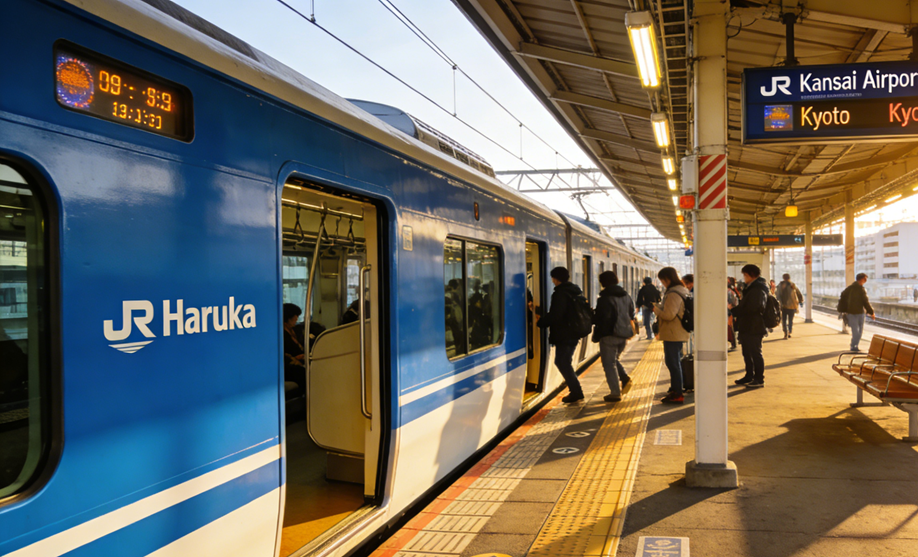
How to Ride the Haruka from KIX to Kyoto
After clearing customs at Kansai Airport, follow signs to the train station on the second floor of Terminal 1. The JR ticket office (Midori-no-Madoguchi) is clearly marked. If you have a Japan Rail Pass, activate it here and reserve your Haruka seat—it's free with the pass. Without a pass, you can buy a ticket at the machine or counter. The train departs from platforms 3 or 4. Board, find your seat (reserved or non-reserved cars), and settle in for the 75-minute ride through Osaka's suburbs and into the Kyoto basin. The internet says it's straightforward, but I've seen confused tourists trying to use IC cards on the Haruka—you need the limited express ticket.
Haruka Luggage Situation: What Works
Unlike local trains, the Haruka has overhead racks and designated luggage spaces near the doors. Large suitcases (up to 160cm) fit in these areas, but they fill up quickly on busy trains. If you have two massive suitcases, book a reserved seat in the front car where there's more space. A common mistake I see: people boarding the wrong car and finding no luggage space, then struggling to block the aisle. If you're traveling during peak seasons like cherry blossom or autumn leaves, reserve early.
From Kyoto Station to Gion: The Final Leg
Arriving at Kyoto Station, you're still 3.5 kilometers from Gion. You have three good options: Taxi (15 minutes, ¥1,500-2,000) – look for the taxi queue at the Hachijoguchi exit. City Bus #206 (20 minutes, ¥230) – board from bus stop A2 on the north side, get off at "Gion" bus stop. Subway Karasuma Line to Subway Tozai Line – take the Karasuma Line to Karasuma-Oike, transfer to Tozai Line to Higashiyama Station, then walk 10 minutes. The taxi is worth the cost if you have luggage—Gion's narrow streets are tough with suitcases.
Late Night Haruka: Last Train Timing
For late night arrivals (after 9:00 PM), check the Haruka schedule carefully. The last Haruka to Kyoto usually departs around 22:16. If you land after that, you're looking at the limousine bus (last departure around 23:00) or an expensive taxi. I've seen families miss the last train by 10 minutes and end up paying ¥60,000 for a taxi—it's a painful lesson. If your flight lands after 8:30 PM, I'd recommend taking the bus instead of rushing.
Using Grab or Uber from Kansai Airport to Gion
Ride-hailing apps like Uber and JapanTaxi work at Kansai Airport, but they're not cheaper than regular taxis. A pre-booked private transfer via apps like "Klook" or "KKday" can be arranged for around ¥40,000-¥50,000. However, standard taxis waiting at the rank charge the same as Uber. For Gion, a taxi is a luxury—you're paying for the convenience of being dropped at a machiya alley where trains don't go. I've used Uber here, and it was seamless, but my wallet hurt afterwards.
Airport Limousine Bus: Kansai Airport to Kyoto & Gion
For many travelers, the Airport Limousine Bus is the unsung hero of KIX-Kyoto transport. It runs from Kansai Airport Terminal 1 (and Terminal 2 with a shuttle) directly to Kyoto Station Hachijoguchi in about 1 hour 40 minutes. Cost: ¥2,800 ($19 USD) one way. The bus has underfloor luggage storage—no struggling with suitcases up stairs. It's slower than the Haruka, but the simplicity is golden, especially for families or anyone with mobility concerns.
Bus Experience: Why It Beats the Train for Some
The internet says trains are always better, but I've watched exhausted parents with strollers and three bags board the bus and relax. You buy your ticket at the machine near the bus stop (or online), queue up, and the driver loads your luggage. You sit, maybe nap, and wake up at Kyoto Station. No platform changes, no elevator hunts. The downside: traffic. If there's an accident on the expressway, the 100-minute ride can stretch to 2.5 hours. But in my experience, it's reliable 90% of the time.
Who Should Take the Bus?
The bus is ideal for: 1) Families with strollers and multiple bags. 2) Senior travelers who find train stations confusing. 3) Anyone arriving after the last Haruka but before 23:00. 4) Travelers with bulky sports equipment (skis, golf bags). 5) Those staying near Kyoto Station (you can taxi to Gion from there). Not ideal for: Anyone in a huge hurry (take the Haruka) or anyone heading directly to Gion without wanting to change (the Keihan train might be better).
Bus from Kyoto Station to Gion: The Connection
Once the limousine bus drops you at Kyoto Station, follow the same steps as the Haruka: taxi (¥1,500-2,000 to Gion) or city bus #206 (¥230, 20 minutes). If you have moderate luggage, take the taxi—the city buses get crowded and have no luggage space. I've seen people try to board bus #206 with a large roller bag at 5 PM—it's not pleasant for anyone.
Keihan Line via Namba: The Budget Route to Gion-Shijo
For budget-conscious travelers who want to emerge directly in Gion, the Keihan Line route via Namba is your ticket. Total cost: ¥2,200-2,500 ($15-17 USD). Total time: About 2 hours. The route: Take the Nankai Line Airport Express from KIX to Namba Station (45 minutes, ¥930-1,000, no reservation needed). At Namba, you need to exit the Nankai gates and walk about 10 minutes (or take a short subway hop) to the Keihan Line's "Kitahama" or "Yodoyabashi" stations. Then board a Keihan Limited Express bound for Demachiyanagi and ride to Gion-Shijo Station (50 minutes, ¥510). Gion-Shijo is literally on the edge of Gion—you walk out and you're steps from the Kamo River and Hanamikoji Street.
Why I Hesitate to Recommend This Route
The internet lists this as a valid option, and technically it is. But I don't actually recommend it for first-timers with luggage. The transfer at Namba is a beast. Namba Station is a sprawling maze of Nankai, Subway, and Keihan lines. You'll walk through shopping arcades, cross streets, and possibly get lost. With a rolling suitcase, it's stressful. I've done it twice: once with just a backpack (fine), once with a medium suitcase (annoying). For the ¥600-800 you save compared to the bus, it's rarely worth the hassle unless you're an experienced Japan traveler.
Who Should Actually Take This Route?
Despite my warning, the Keihan route is excellent for: 1) Backpackers with one small bag who don't mind walking. 2) Travelers staying right near Gion-Shijo Station (you save the final taxi fare). 3) Anyone arriving in the daytime who wants to avoid Kyoto Station chaos. 4) Budget travelers who prioritize saving every yen. If you fit these categories, go for it—just use Google Maps on your phone and allow extra time.
The "Nankai to Keihan" Transfer: Step by Step
If you attempt this, here's the least painful way: At Namba, follow signs for "Exit" towards the Namba Walk underground shopping street. Walk north through Namba Walk towards "Yodoyabashi" direction (about 10 minutes). Alternatively, exit Nankai completely, walk outside to the street, and take the Osaka Metro Midosuji Line one stop from Namba to Yodoyabashi (¥180), then transfer to Keihan. The metro option adds cost but reduces walking with luggage. I learned this after getting lost the first time.
Taxi & Private Transfer: Kansai Airport to Gion
Private Airport Transfer
Taxis and private transfers from Kansai Airport to Gion are the ultimate luxury or necessity. A standard taxi costs ¥50,000-70,000 ($330-470 USD) for the 90-120 minute drive, depending on traffic and tolls. Late night surcharge (after 10 PM) adds 20-30%. You can book through services like "MK Taxi" or "Yasaka Taxi" in advance—they'll meet you at arrivals with a name board. While wildly expensive, for a group of 4 splitting the fare, it's ¥12,500-17,500 per person—comparable to a train ticket plus taxi at the other end, but door-to-door.
When a Taxi Actually Makes Sense
Despite the cost, a taxi is worth considering when: 1) You're a group of 4 with large suitcases (golf bags, etc.). 2) You're arriving very late (after 23:00) and have missed the last bus/train. 3) You have mobility issues or are traveling with elderly parents. 4) You're heading to a specific machiya (traditional townhouse) in Gion's narrow streets that's hard to find. 5) You simply want to start your Kyoto trip in comfort. The internet often dismisses taxis as absurd, but for a special occasion or after a 15-hour flight, that ¥50,000 can feel like money well spent.
Hotel Pickup Services
Many luxury ryokan and hotels in Gion (like "Seikoro" or "Gion Hatanaka") offer airport pickup for a fee, usually ¥40,000-¥60,000. Ask when booking. This is often a private car with a driver who knows exactly where your accommodation is—helpful since some Gion streets are taxi-only or have limited access. Some mid-range hotels might offer a limousine bus ticket package instead. Always confirm in advance, especially if arriving late.
Keihan Line: Detailed Stops from Osaka to Gion-Shijo
If you choose the Keihan Line route (via Namba or Yodoyabashi), understanding the stops helps you navigate. The Keihan Main Line runs from Yodoyabashi in Osaka up to Demachiyanagi in Kyoto, passing right through Gion. Here are the key stations and landmarks along the way from Osaka into the heart of Gion:
Keihan Main Line: Key Stops from Yodoyabashi to Gion-Shijo
- Yodoyabashi Station (淀屋橋) - Starting point in Osaka, connects to Osaka Metro Midosuji Line
- Kitahama Station (北浜) - Transfer point for Keihan Nakanoshima Line
- Temmabashi Station (天満橋) - Connects to Osaka Metro Tanimachi Line
- Kyobashi Station (京橋) - Major transfer hub, connects to JR Loop Line
- Moriguchishi Station (守口市) - Suburban Osaka stop
- Hirakatashi Station (枚方市) - Large suburban hub
- Chushojima Station (中書島) - Transfer for Keihan Uji Line (to Byodo-in)
- Gion-Shijo Station (祇園四条) - Your stop for Gion District, right on the Kamo River
- Sanjo Station (三条) - Next stop after Gion, connects to Tozai Subway Line
- Demachiyanagi Station (出町柳) - Terminal, connects to Eizan Railway
Key Landmarks Near Gion-Shijo Station
- Gion-Shijo Station Exit: Steps from Kamo River and Shijo-dori bridge.
- Hanamikoji Street: 5-minute walk east from the station—main geisha street.
- Yasaka Shrine: 10-15 minute walk east through Gion.
- Kiyomizu-dera: 25-minute walk uphill or short taxi/bus ride.
- Pontocho Alley: Cross Shijo-dori bridge to the west side—5 minutes.
How to Navigate from Gion-Shijo Station to Your Accommodation
Exit Gion-Shijo Station via the "Gion Exit" (not the Sanjo side). You'll be at the intersection of Shijo-dori and the Kamo River. If your hotel is in central Gion (near Hanamikoji), walk east along Shijo-dori and turn right into the narrow streets. If you have heavy luggage, it's worth taking a short taxi from the station—some streets are pedestrian-only or cobblestone. I've dragged a suitcase over cobblestones here, and it's not fun.
Return Trip: Gion to Kansai Airport via Keihan
From Gion-Shijo Station, board a Keihan Limited Express bound for Yodoyabashi. At Yodoyabashi, you can either: 1) Walk to Namba (15-20 minutes) and take Nankai Line back to KIX, or 2) Take the Osaka Metro from Yodoyabashi to Namba (one stop, ¥180) and transfer. Allow 2.5 hours total for the return journey to be safe. For early flights, check the first Keihan train—if it's too late, take a taxi to Kyoto Station and catch the first Haruka instead.
Kansai Airport to Gion District Route Map
The map below shows the primary route from Kansai International Airport (KIX) to Gion District in Kyoto. The most common path is north through Osaka prefecture, either via expressway (bus/taxi) or rail lines hugging the coast before turning inland toward Kyoto.
View the route on Google Maps: View route from Kansai Airport to Gion on Google Maps
The distance from Kansai Airport to Gion District is approximately 100 kilometers (62 miles) by road or rail. The route passes through the southern Osaka suburbs, skirts the edge of Osaka City, and enters Kyoto from the southwest, following the Yodo River valley into the Kyoto Basin where Gion lies on the eastern bank of the Kamo River.
Kansai Airport to Gion: Ticketing & Costs
| Transport Option | Travel Time | Approximate Cost (Yen) | Approximate Cost (USD) | Luggage Space | Best For |
|---|---|---|---|---|---|
| JR Haruka (+ taxi to Gion) | 1 hr 30 min total | ¥3,600 + ¥1,500 = ¥5,100 | $34 USD | Good (overhead + designated) | JR Pass holders, speed, comfort |
| Airport Limousine Bus (+ taxi) | 1 hr 55 min total | ¥2,800 + ¥1,500 = ¥4,300 | $29 USD | Excellent (underfloor storage) | Families, bulky luggage, simplicity |
| Keihan Line via Namba (to Gion-Shijo) | 2 hours | ¥2,200-2,500 | $15-17 USD | Poor (no space, crowded trains) | Backpackers, extreme budget, direct to Gion |
| Taxi / Private Transfer | 90-120 minutes | ¥50,000-70,000 | $330-470 USD | Excellent | Groups of 4+, late night, luxury |
| JR Haruka + City Bus #206 | 1 hr 45 min total | ¥3,600 + ¥230 = ¥3,830 | $25 USD | Poor on bus | Solo travelers, no luggage |
Money Exchange & IC Cards at Kansai Airport
There are plenty of ATMs (7-Bank, Japan Post) in both Terminal 1 and 2. Exchange counters are available but rates are better in Kyoto. Buy an ICOCA card at the JR counter (¥2,000 including ¥1,500 balance)—it works on all trains, subways, and buses in Kyoto (except the Haruka limited express). For the Haruka, you need a separate limited express ticket. Have ¥10,000-20,000 in cash for incidentals—Gion's smaller shops and some taxis are cash-only.
Cost Comparison: What Locals Pay vs. Tourist Prices
Locals pay exactly the same fares—Japanese transport pricing is fixed. The difference is that locals know the shortcuts: using IC cards for seamless transfers, avoiding reserved seat fees on the Haruka by standing in non-reserved cars, and taking the Keihan route without getting lost. As a tourist, you're paying for convenience and simplicity. The ¥2,800 bus is a great deal—it's the same price a Japanese family pays, and you get luggage service included.
Traveler Experience: Getting from Kansai Airport to Gion
Arriving at Kansai International Airport can feel overwhelming—it's a busy hub. But the transport connections are world-class. After clearing immigration and customs (allow 30-60 minutes), follow the signs for "Train" or "Bus" on the second floor. The sheer number of options—Haruka, Nankai, limousine bus, taxis—can paralyze first-timers. But once you pick your route, it's straightforward. The key is knowing which exit leads to your ride.
First-Time Visitor Experience: Haruka Edition
As a first-timer, the Haruka route feels like a rite of passage. You navigate to the JR office, maybe fumble with the ticket machine, and board a sleek white train. The seats are comfortable, and within 20 minutes, you're watching Osaka's skyline blur past. At Kyoto Station, you step out into a modern chaos of buses and taxis. Finding the taxi queue can be confusing—follow the signs to "Hachijoguchi" (the south exit). The taxi driver might not speak English, so have your hotel name in Japanese on your phone. 15 minutes later, you're pulling up to a quiet Gion street. It feels like an adventure, and it is.
The Reality of Kyoto Station Transfers
Kyoto Station is huge. The bus terminal for #206 is on the north side (Karasuma exit), a 5-7 minute walk through the station. With luggage, this walk is annoying. Taxis are lined up at the Hachijoguchi exit—it's faster. The internet says "take the bus, it's cheap," but I've watched tourists struggle to fit suitcases onto packed city buses. The bus driver gave them a look of pure exasperation. If you have more than a backpack, just take the taxi from Kyoto Station to Gion. That ¥1,500 saves your back and dignity.
A Common Example of a Real-Life Mistake
You land at KIX at 21:30 after a 12-hour flight. You're tired, and you see the Haruka train about to depart. You rush, buy a ticket, and board—only to realize you're in a reserved seat car without a reservation. The conductor asks you to move, and all the non-reserved cars are full. You stand for 75 minutes with your suitcase blocking the aisle. You arrive at Kyoto Station exhausted, miss the last easy bus to Gion, and pay ¥3,000 for a taxi. Total stress. If you had waited 30 minutes for the next train with a reserved seat, the trip would have been smooth. I see this happen every time I'm at KIX—don't rush onto a crowded train.
Practical Tips & Advice for Kansai Airport to Gion
- With large luggage: Take the Airport Limousine Bus (underfloor storage) or Haruka (designated luggage space). Avoid the Keihan route during peak hours—it's hell with a suitcase.
- First-time visitor tip: Take the Haruka to Kyoto Station, then a taxi to Gion. It's the least confusing and worth the extra cost for peace of mind.
- Late night travel (after 9:30 PM): Check the last Haruka (around 22:16) and last bus (~23:00). If you miss them, you're looking at a ¥60,000 taxi or staying near the airport. Pre-book a transfer if arriving late.
- Early morning flights: The first Haruka from Kyoto to KIX departs around 6:00 AM. For flights before 9:00 AM, consider staying at a hotel near KIX the night before. I've seen people miss 8:00 AM flights because they gambled on the first train.
- With kids: Limousine bus is best—no platform changes, easy stroller storage, and you can relax. Taxi is also good if budget allows.
- Cost-saving tip: Keihan Line via Namba is cheapest but hardest. If you're solo with a backpack, it's fine. For two people, the bus is only slightly more and way easier.
- Time-saving tip: Haruka is fastest to Kyoto Station. From there, taxi to Gion saves time over bus if you have luggage.
- Group travel (3-4 people): Compare taxi cost to train tickets. ¥60,000 split four ways = ¥15,000 each—similar to Haruka + taxi combo, but door-to-door. Consider a private transfer for convenience.
- Buying tickets: Haruka: JR Ticket Office (English spoken). Bus: Machines near bus stop (English menu). Keihan: Use IC card or ticket machines.
- Weekend vs weekday: Trains run same schedule; buses have similar frequency. Gion is busier on weekends, but transport times are consistent.
- Hotel location in Gion: If you're deep in the historic streets, give the taxi driver a landmark or the hotel's Japanese phone number. Some streets are closed to vehicles.
- Return trip to KIX: From Gion, your best bet is taxi to Kyoto Station (¥1,500-2,000), then Haruka. Allow 2.5-3 hours total for international flights. Book Haruka tickets in advance at Kyoto Station.
- Mobile apps: Download "Japan Travel by Navitime" or "Google Maps" for real-time train schedules. "JapanTaxi" app for hailing cabs. Google Translate for menus and addresses.
- Rainy season (June-July): Taxi or bus are best. Walking between Keihan and Nankai in the rain with luggage is miserable. Haruka is fine—covered platforms.
- Summer (July-August): All options are air-conditioned. Bus and train are comfortable. Drink water—Kyoto is hot.
- SIM cards / WiFi: Rent a pocket WiFi at the airport or buy a data SIM (IIJ, Sakura Mobile) at the KIX electronics shop. Essential for navigation.
- Language: Transport signs are in English and Japanese. Station staff at KIX and Kyoto Station speak basic English. Have addresses written in Japanese.
- Safety: Japan is extremely safe. Keep your belongings close, but theft is rare. Gion is quiet at night—stick to well-lit streets.
- Tipping: Not practiced. Don't tip taxi drivers or porters. Just say "Arigato gozaimasu."
Map showing route from Kansai Airport to Gion via Kyoto Station or Keihan Line.
Frequently Asked Questions: Kansai Airport to Gion District
What is the best way to get from Kansai Airport to Gion?
For most travelers: The JR Haruka limited express train to Kyoto Station, then a taxi or bus to Gion (1 hour 30 minutes, ¥3,600-4,500 / $24-30 USD). This is the most balanced option for speed and comfort. For a direct route without changing stations: The airport limousine bus to Kyoto Station (1 hour 40-50 minutes, ¥2,800 / $19 USD) plus a short taxi ride. The internet says the Haruka is the best, and that's true if you have a JR Pass or value speed, but the bus is better if you dislike navigating train stations with luggage.
Is there a direct train from Kansai Airport to Gion?
There is no direct train that goes straight to Gion. You have two main rail options: 1) Take the JR Haruka express to Kyoto Station (75 minutes, ¥3,600), then transfer to the Karasuma Subway or a taxi to Gion (15-20 minutes). 2) Take the Nankai Line to Namba, transfer to the Keihan Line, and ride to Gion-Shijo Station (2 hours, ¥2,200-2,500). The Keihan option drops you right at the edge of Gion (Gion-Shijo Station) but takes longer and requires more transfers.
How far is Kansai Airport from Gion District?
Kansai International Airport (KIX) is approximately 100 kilometers (62 miles) from Gion District in Kyoto. The travel time by train is 75-90 minutes to Kyoto Station, plus another 15-20 minutes to reach Gion. By direct limousine bus, it's about 1 hour 40 minutes to Kyoto Station. By taxi, the drive takes 90-120 minutes depending on traffic and costs upwards of ¥50,000-¥70,000.
How much is a taxi from Kansai Airport to Gion?
A taxi from Kansai Airport to Gion District costs ¥50,000-¥70,000 ($330-470 USD) for a standard sedan, with a travel time of 90-120 minutes. This is a fixed fare via most taxi companies, but can vary based on time of day and expressway tolls. Late night surcharges (22:00-5:00) add 20-30%. While this is extremely expensive compared to trains, it's the only door-to-door option. For groups of 4 with lots of luggage, splitting a taxi can be comparable to train tickets, but I rarely recommend it unless you have mobility issues or a very late flight.
Is the JR Pass valid for the train from Kansai Airport to Kyoto?
Yes, the Japan Rail Pass (JR Pass) is valid on the JR Haruka limited express train from Kansai Airport to Kyoto Station. However, you must still get a reserved seat ticket at the JR ticket office if you want a guaranteed seat. Pass holders can ride for free, but without a reservation you may have to stand during peak seasons. The Haruka is one of the best ways to activate your pass immediately upon arrival.
What is the cheapest way from Kansai Airport to Gion?
The cheapest way is the Nankai Line transfer to Keihan Line (¥2,200-2,500 / $15-17 USD) taking about 2 hours. You take the Nankai Line Airport Express from KIX to Namba Station (45 minutes, ¥930-1,000), transfer to the Keihan Line (walk 10 minutes or take a short subway), then ride the Keihan Limited Express to Gion-Shijo Station (50 minutes, ¥510). While this is the absolute cheapest rail option, I don't actually recommend it for first-timers with luggage because the transfer at Namba is confusing and involves walking through busy streets. The bus (¥2,800) is a better budget option if you value simplicity.
How do I get from Kansai Airport to Gion by bus?
Take the Airport Limousine Bus from Kansai Airport Terminal 1 to Kyoto Station Hachijoguchi (1 hour 28-50 minutes, ¥2,800 / $19 USD, runs hourly). From Kyoto Station, you can take a taxi to Gion (15 minutes, ¥1,500-2,000) or board city bus #206 from the A2 bus stop to Gion (20 minutes, ¥230). The bus stop for #206 is on the north side of Kyoto Station. The limousine bus itself is comfortable with luggage storage underneath, making it a stress-free option for families.
Which station is closest to Gion?
Gion-Shijo Station on the Keihan Line is the closest train station, located right on the banks of the Kamo River at the edge of the Gion district. From here, you can walk to Hanamikoji Street, Yasaka Shrine, and most Gion attractions within 5-15 minutes. Kyoto Station is the main hub, but it's 3.5 kilometers southwest of Gion—you'll need a bus, taxi, or subway to actually reach Gion from there.
What is the best option for late night arrival at Kansai Airport to get to Gion?
Late night arrivals (after 9:30 PM): Your options are limited. The last Haruka train usually departs around 22:16. The last limousine bus to Kyoto leaves around 23:00. If you arrive after these, your only options are: 1) A pre-booked taxi or private car service (¥50,000+), 2) Taking a train to Osaka (Nankai Line runs later) and staying overnight there, then continuing to Kyoto in the morning, 3) Waiting for the first morning train (around 5:30 AM). I strongly recommend arranging transport in advance if arriving after 9:00 PM, as getting stuck at KIX with no transport and expensive taxis is a common traveler nightmare.
How early should I leave Gion for Kansai Airport for a flight?
For international flights: Leave Gion 3.5-4 hours before departure. Take a taxi from your hotel to Kyoto Station (15 minutes, ¥1,500-2,000), then board the JR Haruka train (75-80 minutes to KIX). Add 30 minutes buffer for train schedules. For morning flights, check the first Haruka departure—if it's too late, consider staying at a hotel near KIX the night before. I've seen people miss international flights because they thought the 8:00 AM train would get them to a 10:30 AM flight—it won't. For domestic flights: 2.5-3 hours before departure is usually safe.
Are there luggage storage lockers at Kansai Airport or Kyoto Station?
Yes: Kansai Airport has large luggage lockers in both Terminal 1 and 2 (¥500-¥800 per day). Kyoto Station has thousands of lockers in the basement and near the north exit, but they fill up quickly by mid-morning (¥400-¥700). There are also luggage delivery services (takkyubin) at both locations—you can have your suitcase sent directly to your hotel in Gion for around ¥2,000 and travel light. This is a pro-tip many travelers miss: ship your large luggage and just take a daypack into Kyoto.
Can I use an IC card (ICOCA, Suica) from Kansai Airport to Gion?
Yes, IC cards work for all routes except the reserved seat on the Haruka express (you need a separate ticket for the limited express supplement). For the Nankai-Keihan route, you can tap through all gates with ICOCA. For the bus from Kyoto Station to Gion, IC cards are accepted. You can buy an ICOCA card at the JR ticket office in Kansai Airport (¥2,000 including ¥1,500 balance and ¥500 deposit). This saves time fumbling for cash on local transport.