Quick Answer
When you first arrive in Tokyo, bring 500-1,500 (¥75K-225K JPY) in cash for immediate expenses, plus accessible funds for larger costs. Essential arrival cash should cover: airport transportation (20-300), temporary accommodation (50-200/night), SIM card (30-100), meals (20-50/day), and initial essentials. First week in Tokyo costs 800-2,500 for singles, 1,500-4,000 for couples, 2,500-7,000+ for families. Have additional accessible funds (3,000-10,000+) ready for apartment deposits within your first week. Japan remains cash-oriented for many initial transactions.
All USD amounts are approximate conversions based on an average exchange rate of 1 USD ≈ 150 JPY. Actual costs may vary.
Airport Arrival Expenses: Immediate Costs Upon Landing in Tokyo
Your financial needs when first arriving in Tokyo begin immediately upon landing at Narita or Haneda airports. Understanding airport arrival expenses helps you prepare adequate cash and payment methods for a smooth transition from airport to city. This section details every cost you'll encounter from the moment you land until you reach your temporary accommodation, including transportation, communication setup, and initial necessities for your first hours in Tokyo.
| Expense Category | Narita Airport | Haneda Airport | Payment Methods | Priority Level |
|---|---|---|---|---|
| Transportation to Tokyo | 25-300 (¥3,020-36,000 JPY) | 5-80 (¥490-9,600 JPY) | Cash, IC Cards, Credit Cards | Essential |
| SIM Card / Pocket WiFi | 30-100 (¥3,600-12,000 JPY) | 30-100 (¥3,600-12,000 JPY) | Cash, Credit Cards | Essential |
| Initial Meal/Drinks | 10-30 (¥1,200-3,600 JPY) | 10-30 (¥1,200-3,600 JPY) | Cash, IC Cards | Essential |
| Suica/Pasmo Card | 5-50 (¥500-6,000 JPY) | 5-50 (¥500-6,000 JPY) | Cash, Credit Cards | Essential |
| Luggage Storage/Locker | 4-20 (¥500-2,400 JPY) | 4-20 (¥500-2,400 JPY) | Cash, IC Cards | Situational |
| Currency Exchange Fees | 1-5% of amount | 1-5% of amount | Cash, Debit Cards | Avoidable |
| Airport Taxi (if needed) | 200-300 (¥24,000-36,000 JPY) | 50-80 (¥6,000-9,600 JPY) | Cash, Credit Cards | Emergency Only |
| Total Airport Arrival Costs | 74-500+ (¥8,820-60,000+ JPY) | 54-260+ (¥6,290-31,200+ JPY) | Multiple Methods | Immediate Needs |
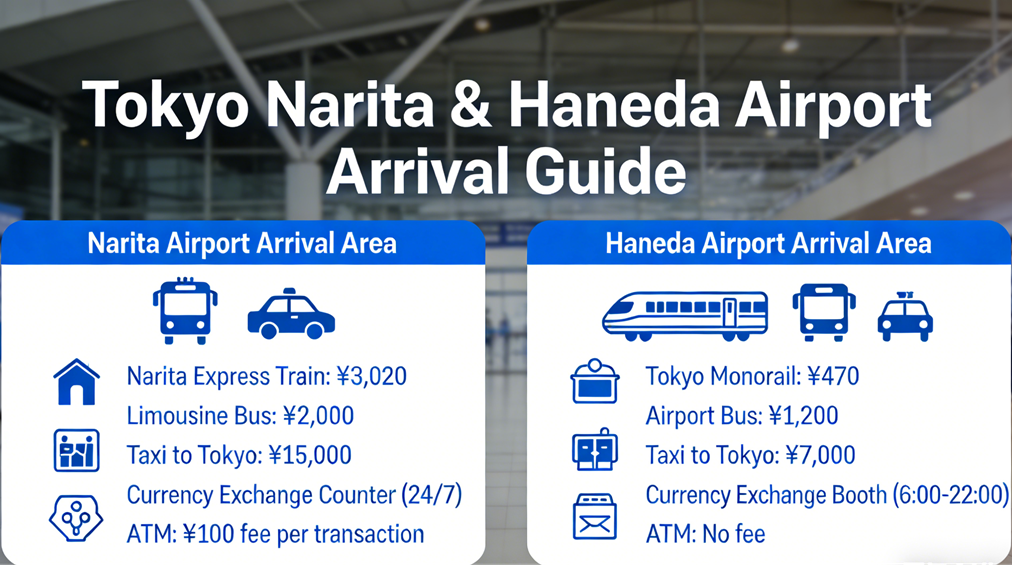
Transportation Options from Tokyo Airports to City Center
Narita Airport to Tokyo options: Narita Express (N'EX) 25-30 (¥3,020-3,670 JPY, 53-85 minutes to Tokyo/Shinjuku), Skyliner 22-26 (¥2,520-3,020 JPY, 41-51 minutes to Ueno/Nippori), Limousine Bus 25-35 (¥3,100-4,300 JPY, 60-120 minutes to major hotels), Regular trains 10-15 (¥1,320-1,940 JPY, 70-100 minutes), Taxi 200-300 (¥24,000-36,000 JPY, 60-90 minutes). Haneda Airport to Tokyo: Tokyo Monorail 5-7 (¥490-650 JPY, 13-23 minutes to Hamamatsucho), Keikyu Line 3-5 (¥300-490 JPY, 11-26 minutes to Shinagawa), Limousine Bus 10-15 (¥1,230-1,850 JPY, 30-60 minutes), Taxi 50-80 (¥6,000-9,600 JPY, 20-40 minutes).
Essential Purchases at Tokyo Airports
Must-buy items at Tokyo airports: SIM Card/Pocket WiFi: Available at airport counters (SoftBank, Docomo, mobile providers) or vending machines. Tourist SIM: 7-30 days, 1-5GB data, 30-100. Resident SIM: Requires registration, 1-24 month plans. Suica/Pasmo Card: Purchase at airport train station vending machines. Load with 20-50 for initial travel. Cash withdrawal: Use 7 Bank or Japan Post ATMs at arrivals. Water/snacks: Convenience stores in arrival areas. Transport tickets: Purchase at ticket machines or counters before exiting airport.
Airport Survival Tips for Tokyo Newcomers
Tokyo airport survival tips: 1. Withdraw cash first: Use 7 Bank ATMs (accept international cards, 24/7). 2. Buy Suica/Pasmo card at station before transportation. 3. Get SIM card if arriving after business hours (some vending machines available). 4. Have hotel address in Japanese for taxi drivers. 5. Use free airport WiFi to contact accommodation/maps. 6. Exchange minimal cash at airport (poor rates). 7. Keep passport accessible for SIM purchase registration. 8. Download offline maps before arrival. 9. Note last train times if arriving late (around midnight). 10. Have backup transportation funds in case of issues.
First Day & Night Costs: Essential Expenses Upon Tokyo Arrival
Your first day and night in Tokyo involve essential expenses for basic survival and initial setup. These immediate Tokyo arrival costs cover accommodation, meals, transportation, and necessities before you begin apartment hunting or long-term planning. This section provides a detailed breakdown of what you'll spend during your first 24 hours in Tokyo, with practical budgeting strategies for different arrival scenarios and traveler types.
First 24-Hour Expense Breakdown in Tokyo
| Time Period | Expense Category | Single Person | Couple | Family of 4 | Payment Methods |
|---|---|---|---|---|---|
| Hours 1-4 (Airport) | Transport to City | 20-100 (¥2,400-12,000 JPY) | 40-200 (¥4,800-24,000 JPY) | 80-400 (¥9,600-48,000 JPY) | Cash, Cards |
| SIM Card/Data | 30-100 (¥3,600-12,000 JPY) | 50-150 (¥6,000-18,000 JPY) | 80-250 (¥9,600-30,000 JPY) | Cash, Cards | |
| Initial Meals/Water | 10-30 (¥1,200-3,600 JPY) | 20-50 (¥2,400-6,000 JPY) | 30-80 (¥3,600-9,600 JPY) | Cash, IC Cards | |
| Transport Card Load | 20-50 (¥2,400-6,000 JPY) | 30-80 (¥3,600-9,600 JPY) | 50-150 (¥6,000-18,000 JPY) | Cash, Cards | |
| Hours 5-12 (Settling) | First Night Accommodation | 50-200 (¥6,000-24,000 JPY) | 80-300 (¥9,600-36,000 JPY) | 150-500 (¥18,000-60,000 JPY) | Cash, Cards |
| Dinner | 10-40 (¥1,200-4,800 JPY) | 20-60 (¥2,400-7,200 JPY) | 40-100 (¥4,800-12,000 JPY) | Cash, IC Cards | |
| Toiletries/Essentials | 30-100 (¥3,600-12,000 JPY) | 40-120 (¥4,800-14,400 JPY) | 60-200 (¥7,200-24,000 JPY) | Cash | |
| Local Transportation | 5-20 (¥600-2,400 JPY) | 8-30 (¥960-3,600 JPY) | 15-50 (¥1,800-6,000 JPY) | IC Cards, Cash | |
| Hours 13-24 (Next Day) | Breakfast | 5-20 (¥600-2,400 JPY) | 10-30 (¥1,200-3,600 JPY) | 20-50 (¥2,400-6,000 JPY) | Cash, IC Cards |
| Administrative Travel | 5-20 (¥600-2,400 JPY) | 8-30 (¥960-3,600 JPY) | 15-50 (¥1,800-6,000 JPY) | IC Cards | |
| Incidental Expenses | 20-100 (¥2,400-12,000 JPY) | 30-150 (¥3,600-18,000 JPY) | 50-250 (¥6,000-30,000 JPY) | Cash, Cards | |
| Total First 24 Hours | Essential Expenses | 205-680 (¥24,600-81,600 JPY) | 336-1,200 (¥40,320-144,000 JPY) | 590-2,180 (¥70,800-261,600 JPY) | Multiple Methods |
Accommodation Options for Your First Night in Tokyo
First night accommodation in Tokyo: Capsule hotels 30-60 (¥3,600-7,200 JPY) - single travelers only, often male/female separated. Business hotels 60-150 (¥7,200-18,000 JPY) - convenient, small rooms, good locations. Hostels 25-50 (¥3,000-6,000 JPY) per bed - social, budget option. Love hotels 50-100 (¥6,000-12,000 JPY) - hourly/daily rates, some accept couples. Airbnb 70-200 (¥8,400-24,000 JPY) - apartment style, may require advance booking. Internet/manga cafes 20-40 (¥2,400-4,800 JPY) - cubicle with computer, shower available. 24-hour spas 30-60 (¥3,600-7,200 JPY) - with sleeping areas. Book in advance, especially for late arrivals.
First Meal Strategies in Tokyo
First meal strategies in Tokyo: Convenience stores (7-Eleven, FamilyMart, Lawson): bento boxes 3-6 (¥360-720 JPY), onigiri 1-2 (¥120-240 JPY), sandwiches 2-4 (¥240-480 JPY). Fast food: McDonald's, Mos Burger, Yoshinoya 5-10 meals (¥600-1,200 JPY). Department store basements (depachika): prepared foods 5-15 (¥600-1,800 JPY). Ramen shops: 8-12 (¥960-1,440 JPY) for filling meal. Supermarket evening discounts: 30-50% off prepared foods after 7-8 PM. Food courts in stations: variety options 8-15 (¥960-1,800 JPY). Eat cheaply first day, splurge once settled. Have cash ready as some small places are cash-only.
First Week Budget: Essential Expenses for Your Initial 7 Days in Tokyo
Your first week budget in Tokyo covers essential living expenses while you secure longer-term accommodation, open bank accounts, and complete administrative tasks. This 7-day Tokyo survival budget includes accommodation, food, transportation, communication, and initial setup costs before larger expenses like apartment deposits. Proper planning for your first week prevents financial stress during this critical transition period in Tokyo.
Detailed First Week Expense Breakdown in Tokyo
| Expense Category | Single Person (Budget) | Single Person (Comfortable) | Couple (Budget) | Couple (Comfortable) | Family of 4 (Budget) | Family of 4 (Comfortable) |
|---|---|---|---|---|---|---|
| 7 Nights Accommodation | 350-700 (¥42K-84K JPY) | 700-1,400 (¥84K-168K JPY) | 560-1,120 (¥67.2K-134.4K JPY) | 1,120-2,240 (¥134.4K-268.8K JPY) | 1,050-2,100 (¥126K-252K JPY) | 2,100-4,200 (¥252K-504K JPY) |
| Food (21 meals) | 210-420 (¥25.2K-50.4K JPY) | 420-840 (¥50.4K-100.8K JPY) | 350-700 (¥42K-84K JPY) | 700-1,400 (¥84K-168K JPY) | 630-1,260 (¥75.6K-151.2K JPY) | 1,260-2,520 (¥151.2K-302.4K JPY) |
| Transportation | 50-150 (¥6K-18K JPY) | 100-300 (¥12K-36K JPY) | 80-240 (¥9.6K-28.8K JPY) | 160-480 (¥19.2K-57.6K JPY) | 150-450 (¥18K-54K JPY) | 300-900 (¥36K-108K JPY) |
| Communication | 30-100 (¥3.6K-12K JPY) | 50-150 (¥6K-18K JPY) | 50-150 (¥6K-18K JPY) | 80-240 (¥9.6K-28.8K JPY) | 80-240 (¥9.6K-28.8K JPY) | 120-360 (¥14.4K-43.2K JPY) |
| Essentials/Toiletries | 50-150 (¥6K-18K JPY) | 100-300 (¥12K-36K JPY) | 80-240 (¥9.6K-28.8K JPY) | 160-480 (¥19.2K-57.6K JPY) | 150-450 (¥18K-54K JPY) | 300-900 (¥36K-108K JPY) |
| Administrative Costs | 0-100 (¥0-12K JPY) | 0-200 (¥0-24K JPY) | 0-150 (¥0-18K JPY) | 0-300 (¥0-36K JPY) | 0-250 (¥0-30K JPY) | 0-500 (¥0-60K JPY) |
| Incidental Expenses | 50-200 (¥6K-24K JPY) | 100-400 (¥12K-48K JPY) | 80-320 (¥9.6K-38.4K JPY) | 160-640 (¥19.2K-76.8K JPY) | 150-600 (¥18K-72K JPY) | 300-1,200 (¥36K-144K JPY) |
| Total First Week | 740-1,820 (¥88.8K-218.4K JPY) | 1,470-3,590 (¥176.4K-430.8K JPY) | 1,200-2,920 (¥144K-350.4K JPY) | 2,380-5,780 (¥285.6K-693.6K JPY) | 2,210-5,350 (¥265.2K-642K JPY) | 4,380-10,580 (¥525.6K-1.27M JPY) |
Accommodation Strategies for Your First Week in Tokyo
First week accommodation strategies in Tokyo: Week 1 option 1: Stay in same place entire week (weekly mansion: 400-800, business hotel: 420-1,050, share house: 350-560). Option 2: 2-3 nights cheap accommodation while searching, then move to better place. Option 3: Corporate housing if employer provides. Option 4: Serviced apartment for families. Location considerations: Stay near major transit hubs (Shinjuku, Shibuya, Tokyo Station) for easy apartment hunting access. Booking tips: Reserve first 3-4 nights before arrival, extend as needed. Cost-saving: Weekly rates typically 20-30% cheaper than nightly. Share houses cheapest but less privacy.
First Week Timeline: What to Pay When in Tokyo
Tokyo first week payment timeline: Day 1: Airport costs, first night accommodation, initial food, SIM card. Day 2: Extend accommodation, grocery shopping, toiletries, transportation card reload. Day 3: Bank account opening (some banks have fees), administrative travel costs. Day 4-5: Continue daily expenses, apartment hunting transportation costs. Day 6-7: Possible apartment application fees, continued living expenses. Payment methods evolution: Days 1-3: mostly cash. Days 4-7: begin using Japanese bank account/cards. Have accessible funds ready for potential apartment application costs by day 5-7.
Cash vs Card Payment Guide for Tokyo Newcomers
Understanding cash versus card usage in Tokyo is crucial for managing your finances upon arrival. Japan maintains a cash-oriented society for many transactions, especially for newcomers without established Japanese banking. This guide details when to use cash, when cards are accepted, and optimal payment strategies for your first days and weeks in Tokyo, helping you avoid payment issues and manage your money effectively.
Cash-Only Situations in Tokyo
| Situation/Location | Cash Required Amount | Alternatives | Frequency | Tips |
|---|---|---|---|---|
| Small Restaurants/Izakaya | 10-50 per meal (¥1,200-6,000 JPY) | None typically | Daily | Check for cash-only signs (現金のみ) |
| Traditional Markets | 5-50 (¥600-6,000 JPY) | Rarely cards | Weekly | Carry small bills for food stalls |
| Temples/Shrines | 1-10 donations (¥100-1,200 JPY) | None | Occasional | Have coins for offering boxes |
| Local Transportation (Some) | 2-20 (¥240-2,400 JPY) | Suica/Pasmo cards | Daily | Get IC card immediately |
| Vending Machines (Some) | 1-3 (¥120-360 JPY) | IC cards on newer machines | Daily | Coins or ¥1,000 bills accepted |
| Public Baths/Sentos | 5-10 (¥600-1,200 JPY) | None typically | Weekly | Exact change often appreciated |
| Small Shops/Stalls | 5-100 (¥600-12,000 JPY) | None typically | Daily | Especially outside tourist areas |
| Parking Meters | 1-5 per hour (¥100-600 JPY) | Some accept cards | If driving | Coins only at many meters |
| Rural Areas | Varies widely | Limited acceptance | When traveling | Carry extra cash outside cities |
Card-Friendly Situations in Tokyo
Places accepting cards in Tokyo: Department stores (Isetan, Mitsukoshi, Takashimaya), Major retail chains (Uniqlo, Muji, Bic Camera, Yodobashi), Convenience stores (7-Eleven, FamilyMart, Lawson - all major cards), Hotels (especially international chains), Chain restaurants (McDonald's, Starbucks, family restaurants), Airline tickets, Online shopping, Some taxis (look for card stickers), Large electronics stores. Card types accepted: Visa and MasterCard most widely, Amex less common, Discover rarely. Contactless payments: Growing with Suica/Pasmo, Apple Pay, Google Pay. Still, always carry cash as backup.
Optimal Cash-Card Strategy for Tokyo Arrival
Optimal payment strategy for Tokyo arrival: 1. Carry ¥20,000-50,000 JPY cash daily. 2. Use cards for large purchases (over ¥10,000 JPY). 3. Get Suica/Pasmo card immediately for transit, convenience stores, vending machines. 4. Use convenience store ATMs for cash withdrawals (7-Eleven, FamilyMart). 5. Inform home bank of travel to avoid card blocks. 6. Have multiple payment methods: cash, 2+ cards from different networks, travel money card. 7. Withdraw larger amounts to reduce ATM fees. 8. Use cards at night when ATMs less accessible. 9. Keep emergency cash separate from daily cash. 10. Transition to Japanese banking as soon as possible (within first week).
Accessing Your Money When First Arriving in Tokyo
Accessing money when first arriving in Tokyo requires planning due to potential issues with foreign cards, banking hours, and currency exchange availability. This section provides comprehensive strategies for accessing funds in Tokyo during your initial days, including ATM locations, banking options, international transfers, and practical solutions for common financial access challenges faced by newcomers to Japan.
ATM Access Points for Foreign Cards in Tokyo
| ATM Location | Card Acceptance | Hours | Fees | Withdrawal Limits | English Interface |
|---|---|---|---|---|---|
| 7-Eleven ATMs | Visa, MC, Amex, Plus, Cirrus | 24/7 | ¥110-220 JPY + home bank fees | ¥10,000-50,000 per transaction | Yes |
| Japan Post Bank ATMs | Visa, MC, Plus, Cirrus | 8:45-21:00 weekdays, 9:00-21:00 weekends | ¥110-220 JPY + home bank fees | ¥10,000-100,000 per day | Yes |
| FamilyMart ATMs | Visa, MC, Amex, JCB | 24/7 | ¥110-220 JPY + home bank fees | ¥10,000-50,000 per transaction | Yes |
| Lawson ATMs | Visa, MC, UnionPay | 24/7 | ¥110-220 JPY + home bank fees | ¥10,000-50,000 per transaction | Yes |
| Mizuho Bank ATMs | Visa, MC, Plus, Cirrus | 8:45-19:00 weekdays, 9:00-19:00 weekends | ¥110-220 JPY + home bank fees | ¥10,000-100,000 per day | Sometimes |
| Airport ATMs (7 Bank) | Most international cards | 24/7 | ¥110-220 JPY + home bank fees | ¥10,000-50,000 per transaction | Yes |
| Citibank ATMs (Now SMBC) | Most international cards | 8:45-20:00 | ¥0-220 JPY + home bank fees | ¥10,000-200,000 per day | Yes |
Opening a Japanese Bank Account as a New Arrival
Opening Japanese bank account as new arrival: Requirements: Residence card, passport, Japanese phone number, address (temporary may work), personal seal (inkan) or signature. Timeline: Can open within first week, but some banks require 6-month residency. Recommended banks for newcomers: Japan Post Bank (most accessible, minimal requirements), Shinsei Bank (foreigner-friendly, English support), SMBC Prestia (English services, former Citibank). Process: Visit branch with documents, complete forms, receive bankbook and cash card immediately (ATM card may arrive later). Initial deposit: ¥1,000-5,000 JPY typically. Open account early to receive salary, pay rent, and reduce international transaction fees.
International Money Transfer Options to Tokyo
International money transfer to Tokyo options: 1. Bank wire transfer: 3-5 business days, 20-50 fees, need Japanese bank account details. 2. TransferWise (Wise): 1-2 business days, lower fees (0.5-1.5%), good exchange rates, can send to Japanese bank account. 3. PayPal: Instant to other PayPal users, 2-5% fees, can transfer to Japanese bank. 4. MoneyGram/Western Union: Cash pickup locations, minutes to hours, 2-10% fees. 5. Revolut: Good exchange rates, transfer to other Revolut users. 6. Cryptocurrency: Bitcoin/other, exchange to JPY at Japanese exchanges. For initial arrival: Have funds accessible via ATM cards, then use Wise for larger transfers once Japanese account opened.
Currency Exchange Strategies for Tokyo Arrival
Currency exchange strategies for Tokyo arrival significantly impact how much yen you receive for your money. With various exchange options offering different rates and fees, choosing the right yen exchange method can save you hundreds of dollars during your initial setup in Tokyo. This section compares exchange options, provides timing strategies, and offers practical tips for getting the best conversion rates when exchanging money for your Tokyo relocation.
Currency Exchange Options Comparison for Tokyo
| Exchange Method | Exchange Rate | Fees | Convenience | Best For | Worst For |
|---|---|---|---|---|---|
| Home Bank Before Travel | Fair to Good | 0-2% | High (pre-arrival) | Initial cash needs | Large amounts |
| Tokyo Airport ATMs | Excellent (interbank rate) | ¥110-220 + home bank fees | High (24/7 at airport) | First withdrawal | Those without ATM cards |
| Convenience Store ATMs | Excellent (interbank rate) | ¥110-220 + home bank fees | Very High (24/7 everywhere) | Daily cash needs | Those wanting to avoid fees |
| Japanese Bank Exchange | Fair to Good | 0.5-3% | Medium (business hours) | Large amounts with account | Small amounts |
| Currency Exchange Counters | Poor to Fair | 3-10% | High (airports, tourist areas) | Emergency only | Anyone wanting good rates |
| Hotel Exchange | Very Poor | 5-15% | High (in hotel) | Extreme emergency only | Everyone else |
| Credit Card Purchases | Excellent (interbank rate) | 0-3% foreign transaction fee | High where accepted | Large purchases | Cash-only places |
| Wise (TransferWise) | Excellent | 0.5-1.5% | Medium (requires Japanese account) | Large transfers after account setup | Immediate cash needs |
Optimal Currency Exchange Strategy for Tokyo Arrival
Optimal currency exchange strategy for Tokyo arrival: 1. Before departure: Exchange 200-500 at home bank for immediate needs. 2. At airport: Withdraw ¥20,000-50,000 from 7 Bank ATM (best rates). 3. First week: Use 7-Eleven/FamilyMart ATMs for additional cash as needed. 4. After bank account opened: Use Wise for larger transfers from home country. 5. Daily use: Use credit card where accepted (no foreign transaction fee cards best). 6. Always avoid: Airport exchange counters, hotel exchanges, standalone exchange kiosks. 7. Monitor rates: Use XE.com or similar to time larger transfers. 8. Carry backup cash in home currency for extreme emergencies.
Managing Exchange Rate Risk for Tokyo Relocation
Managing exchange rate risk for Tokyo move: 1. Exchange in batches: Convert 25% before arrival, 25% first week, 25% first month, 25% as needed. 2. Use limit orders: With Wise/Revolut, set target exchange rate for automatic conversion. 3. Hedge with multi-currency accounts: Keep funds in both currencies, convert when rates favorable. 4. Monitor economic indicators: JPY often strengthens during crises, weakens during stability. 5. Consider forward contracts: For very large amounts ($50,000+), lock in rate with bank. 6. Diversify timing: Don't convert all funds at once. 7. Budget conservatively: Assume slightly worse rates than current when planning. 8. Have buffer: Extra 5-10% for rate fluctuations during your Tokyo setup period.
Emergency Cash Requirements for Tokyo Arrival
Emergency cash requirements for Tokyo arrival provide financial security during unexpected situations in your initial days. From missed connections to medical issues, having accessible emergency funds in Tokyo ensures you can handle crises without added stress. This section details how much emergency cash to bring, where to keep it, and scenarios where you'll need immediate access to funds during your first week in Tokyo.
Emergency Fund Breakdown for Tokyo Arrival
| Emergency Scenario | Recommended Emergency Fund | Cash Required | Card Accessible | Likelihood | Preparation Tips |
|---|---|---|---|---|---|
| Missed/Late Arrival Accommodation | 100-300 (¥12K-36K JPY) | Yes | Yes | Medium | Have 24-hour hotel options |
| Lost/Stolen Wallet | 200-500 (¥24K-60K JPY) | Separate stash | Backup cards | Low | Keep cash/cards in multiple places |
| Medical Emergency | 300-1,000 (¥36K-120K JPY) | Partial | Yes | Low | Have travel insurance details |
| Transportation Issues | 50-200 (¥6K-24K JPY) | Yes | Yes | Medium | Know taxi alternatives |
| Communication Failure | 50-150 (¥6K-18K JPY) | Yes | No (needs phone) | Low-Medium | Have offline maps/phrases |
| Banking/Card Issues | 500-1,000 (¥60K-120K JPY) | Yes | Backup cards | Low-Medium | Multiple cards, inform banks |
| Natural Disaster | 200-500 (¥24K-60K JPY) | Yes | Maybe not | Low (but high impact) | Know evacuation routes |
| Unexpected Fees/Costs | 100-300 (¥12K-36K JPY) | Partial | Yes | Medium | Budget 10-20% buffer |
| Total Emergency Fund Recommended | 1,000-3,000 (¥120K-360K JPY) | 500-1,500 accessible | Remainder accessible | Varies | Separate from daily funds |
Emergency Cash Storage Strategies in Tokyo
Emergency cash storage strategies for Tokyo: 1. Multiple locations: Some in wallet, some in luggage, some on person (money belt/neck pouch). 2. Hotel safe: When available, store backup cash and documents. 3. Separate currencies: Keep $200-500 in home currency for extreme emergencies. 4. Digital backupEmergency contact: Have someone who can wire money if needed. 6. Access hierarchy: Daily cash (wallet), short-term backup (hotel), long-term emergency (separate location). 7. Communication plan: How to access funds if phone/wallet lost. 8. Regular check: Verify emergency funds daily first week. Don't keep all emergency cash in one place in Tokyo.
Emergency Services and Free Assistance in Tokyo
Free emergency services in Tokyo: Police (110): Free assistance for theft, loss, emergencies. Ambulance/Fire (119): Free emergency medical response. Embassy/Consulate: Home country assistance, some emergency loans for citizens. Tourist Information Centers: Free maps, assistance, sometimes phone charging. Hospital emergency rooms: Must treat emergencies regardless of payment ability (pay later). Community centers: Sometimes offer assistance to foreigners. Free WiFi spots: Stations, convenience stores, cafes for communication. Public phones: Can call emergency services without coins. Know these Tokyo emergency resources before needing them.
Tokyo Arrival Budget Scenarios: Realistic First Week Examples
Tokyo arrival budget scenarios illustrate how different travelers experience first week costs in Tokyo based on travel style, accommodation choices, and spending habits. These realistic examples help you visualize potential expenses and plan your own Tokyo arrival budget. Each scenario includes actual expense breakdowns and key lessons learned from real Tokyo arrivals, covering different traveler types and financial situations.
First Week Budget Scenarios for Different Traveler Types
| Traveler Profile | Total First Week Cost | Accommodation | Food | Transport/Other | Key Strategies |
|---|---|---|---|---|---|
| Backpacker (Hostels, cooking) | $580 (¥69,600 JPY) | $210 (7 nights hostel) | $140 (cook most meals) | $230 (incidentals, SIM, transit) | Hostels, supermarket cooking, walking |
| Budget Traveler (Business hotels, mix meals) | $980 (¥117,600 JPY) | $490 (7 nights business hotel) | $280 (mix cooking/eating out) | $210 (transport, SIM, essentials) | Weekly hotel discounts, convenience store meals |
| Comfort Traveler (3-star hotel, restaurants) | $1,850 (¥222,000 JPY) | $1,050 (7 nights hotel) | $500 (restaurants daily) | $300 (taxis, SIM, shopping) | Hotel near transit, restaurant lunch specials |
| Family of 4 (Apartment, cooking) | $2,450 (¥294,000 JPY) | $1,400 (7 nights Airbnb) | $700 (cooking at home) | $350 (transport, essentials, SIMs) | Apartment with kitchen, family transit passes |
| Business Traveler (4-star hotel, expenses) | $2,800 (¥336,000 JPY) | $1,750 (7 nights hotel) | $700 (restaurants/business meals) | $350 (taxis, SIM, work expenses) | Hotel points, expense account where possible |
| Luxury Traveler (5-star, fine dining) | $5,200+ (¥624,000+ JPY) | $3,500+ (7 nights luxury) | $1,200+ (fine dining daily) | $500+ (private cars, shopping) | Concierge services, premium everything |
Case Study: Solo Arrival with $1,000 First Week Budget
Profile: 28-year-old arriving for job starting in 2 weeks. Budget: 1,000 (¥120,000 JPY) for first week. Breakdown: Accommodation (share house weekly): 200. Food (cooking at home + some eating out): 200. Transportation (Suica card, some taxis): 150. SIM card (1-month data): 50. Toiletries/essentials: 100. Administrative costs (bank fees, etc.): 50. Apartment hunting transportation: 100. Emergency buffer: 150. Actual spending: 920 total. Key strategies: Share house provided community and reduced loneliness. Cooked breakfast/dinner at home, bought lunch specials. Used bicycle for local trips. Bought second-hand essentials. Successful within budget with $80 remaining.
Case Study: Family of 4 Arrival with Corporate Support
Profile: Family with 2 children (6 and 9), corporate relocation. Budget: Company provided 5,000 advance + corporate apartment first month. Personal funds used: 2,800 (¥336,000 JPY) first week. Breakdown: Food (groceries + some restaurants): 800. Transportation (taxis initially, then trains): 400. School-related costs (uniforms, supplies): 600. Essentials for apartment (basic furnishings): 500. SIM cards/phones for family: 300. Entertainment/exploration: 200. Corporate support: Apartment, airport pickup, initial orientation. Key insights: Even with corporate support, personal funds needed for daily life. Children's needs added significant costs. First week focused on school setup and basic living establishment. Budget sufficient but required careful management.
Money Management Tips for Your Tokyo Arrival
- Prepare multiple payment methods: Bring 2-3 credit/debit cards from different banks/networks. Have both Visa and MasterCard. Include an ATM card with 4-digit PIN (6-digit may not work). Bring some cash in your home currency for emergencies. Consider travel money cards (Wise, Revolut) for better exchange rates.
- Inform your banks before departure: Notify all card issuers of travel dates and destinations. Provide phone number where you can be reached abroad. Set travel notifications on online banking. Know international customer service numbers. Understand daily withdrawal limits and fees for international use.
- Exchange currency strategically: Exchange small amount before departure for immediate needs. Use airport ATMs upon arrival for best rates. Withdraw larger amounts to minimize ATM fees. Avoid exchange counters with poor rates. Monitor exchange rates for optimal timing of larger transfers.
- Get Japanese transportation card immediately: Purchase Suica or Pasmo card at airport station. Load with ¥3,000-5,000 initially. Use for trains, buses, convenience stores, vending machines. Register card if staying long-term (enables balance recovery if lost). Consider commuter pass once workplace/school determined.
- Prioritize cash for first week: Withdraw ¥50,000-100,000 for first week expenses. Keep in secure locations (not all in wallet). Have small bills and coins for vending machines, buses, small purchases. Use credit cards for larger purchases at major retailers. Assume many places are cash-only until proven otherwise.
- Open Japanese bank account early: Visit Japan Post Bank or Shinsei Bank within first week. Bring required documents: passport, residence card, address, phone number. Start with basic account, upgrade as needed. Get cash card for ATM access. Set up online banking for transfers and management.
- Track expenses from day one: Use expense tracking app or notebook. Record every expenditure to understand spending patterns. Categorize expenses: accommodation, food, transport, essentials. Compare actual spending to budget daily. Adjust spending based on remaining funds.
- Understand Japanese receipt culture: Receive receipts (reshito) for all purchases. Keep for expense tracking and potential returns. Some receipts have point cards or coupons on back. Organize receipts by category for easy reference. Discard only after verifying no returns needed.
- Learn basic money phrases: "Ikura desu ka?" (How much?), "Kurejitto kaado wa tsukaemasu ka?" (Can I use credit card?), "Genkin de onegaishimasu" (Cash please), "Okaikei onegaishimasu" (Check please), "Otsuri wa irimasen" (No change needed). Use phone translation apps for complex transactions.
- Use convenience stores for financial services: 7-Eleven, FamilyMart, Lawson ATMs accept foreign cards. Pay bills at convenience store counters. Send/receive packages. Print documents. Buy tickets for events/transportation. Access free WiFi. Open 24/7 for emergency needs.
- Set up phone/internet immediately: Get SIM card at airport or major electronics store. Consider data-only SIM initially if keeping home number. Compare MVNO providers for best rates. Set up mobile payments (Apple Pay/Google Pay with Suica). Ensure phone is unlocked before arrival.
- Budget for unexpected expenses: Include 10-20% buffer in your arrival budget. Have emergency cash separate from daily funds. Know locations of your embassy/consulate for extreme emergencies. Have insurance information accessible. Know how to contact home for emergency funds transfer.
- Manage time-sensitive expenses: Some costs are time-critical: residence registration within 14 days, bank account opening for salary receipt, phone contract for apartment applications. Plan your first week around these deadlines. Have necessary documents ready. Allocate funds for associated costs (transportation to ward office, potential fees).
- Keep digital records of financial documents: Photograph passport, visa, credit cards, insurance cards. Store securely in cloud with encryption. Have digital copies accessible offline. Share with trusted contact back home. Update as you get new documents (residence card, bank book).
- Understand Japanese billing cycles: Many services bill monthly, often at end of month. Some require initial setup fees. Utilities may require deposits. Rent typically paid in advance. Plan cash flow accordingly, especially before first paycheck arrives.
- Final arrival day checklist: 1. Confirm accessible funds, 2. Exchange emergency cash, 3. Set up phone data, 4. Buy transportation card, 5. Reach accommodation, 6. Inform contacts of safe arrival, 7. Rest and hydrate, 8. Plan next day's priorities. Take it slow the first 24 hours to avoid costly mistakes from exhaustion.
Map showing key financial access points in Tokyo: airport ATMs, 24-hour convenience stores with ATMs, major bank branches, currency exchange locations, and emergency services for newcomers.
Frequently Asked Questions: Money When First Arriving in Tokyo
How much cash should I bring when I first arrive in Tokyo?
Bring $500-$1,500 (¥75K-225K JPY) in cash when you first arrive in Tokyo. This covers airport transportation, initial meals, SIM card purchase, and first few days expenses before you open a Japanese bank account. Also have $3,000-$10,000+ accessible via ATM cards/credit cards for larger expenses. Japan is still cash-oriented for many transactions, especially initial setup purchases. Distribute cash in multiple secure locations (wallet, luggage, money belt).
How much yen should I have at the airport in Tokyo?
Have ¥20,000-50,000 JPY ($130-$330) in Japanese yen when landing at Tokyo airports. This covers: transportation to city ($20-$100), SIM card ($30-$100), initial meal ($10-$30), and emergency buffer. Exchange some currency before arrival or use airport ATMs. Have additional funds accessible via cards. Narita/Haneda airports have 24-hour ATMs, currency exchange, and accept major credit cards for larger purchases. Withdraw from airport ATMs for best exchange rates.
What should I pay for in cash when first arriving in Tokyo?
Pay in cash when first arriving in Tokyo for: airport transportation (train/bus/taxi), convenience store purchases, SIM cards at airport, vending machine drinks, small eateries, taxi rides, and initial grocery shopping. Many small businesses, traditional restaurants, and services prefer cash. Credit cards accepted at major retailers, hotels, and chain restaurants. Have cash for first 3-7 days until bank account is established. Always ask "Kurejitto kaado wa tsukaemasu ka?" to check if cards accepted.
Should I exchange money before arriving in Tokyo?
Exchange $200-$500 (¥30K-75K JPY) before arriving in Tokyo for immediate expenses. Get better rates at your home bank or specialist exchange services. For larger amounts, use Tokyo airport ATMs (7 Bank, Japan Post) with international cards for better rates. Avoid airport exchange counters for large amounts due to poor rates. Bring crisp, undamaged US dollars or Euros for best exchange rates. Have multiple payment methods: cash, credit cards, debit cards, travel money cards for flexibility.
How much does it cost from the airport to Tokyo?
Airport to Tokyo costs: Narita Express train $25-$30 (¥3,020-3,670 JPY), Skyliner $22-$26 (¥2,520-3,020 JPY), Limousine Bus $25-$35 (¥3,100-4,300 JPY), taxi $200-$300 (¥24,000-36,000 JPY). Haneda Airport: Monorail $5-$7 (¥490-650 JPY), Keikyu Line $3-$5 (¥300-490 JPY), Limousine Bus $10-$15 (¥1,230-1,850 JPY), taxi $50-$80 (¥6,000-9,600 JPY). Have cash for tickets as some machines don't accept foreign cards. Consider prepaid transportation cards (Suica/Pasmo) for convenience and wider acceptance.
What are the first things I need to pay for in Tokyo?
First things to pay for in Tokyo: 1. Airport transportation to city ($20-$300), 2. Temporary accommodation first night ($50-$200), 3. SIM card/data ($30-$100), 4. First meals ($20-$50), 5. Transportation card (Suica/Pasmo: $5-$20 load), 6. Toiletries/essentials ($30-$100), 7. Bank account opening fees (some banks), 8. Residence registration transport costs. Total first day: $200-$800 depending on choices. Have accessible funds for apartment deposits within first week ($4,000-$25,000+).
Can I use foreign credit cards in Tokyo?
Yes, major foreign credit cards (Visa, MasterCard, Amex) work in Tokyo at: major hotels, department stores, chain restaurants, convenience stores (7-Eleven, FamilyMart, Lawson), large retailers, and some transportation. However, many small restaurants, local shops, traditional businesses, and services are cash-only. Some ATMs don't accept foreign cards. Have at least 2 cards from different networks. Inform your bank of travel to Japan to avoid blocks. Cards with no foreign transaction fees are best for saving money.
Where should I get yen when I arrive in Tokyo?
Get yen in Tokyo at: 1. Airport ATMs (7 Bank, Japan Post - 24 hours, English available, good rates), 2. Convenience store ATMs (7-Eleven, FamilyMart, Lawson - accept foreign cards), 3. Japan Post Bank ATMs (widely available, English interface), 4. Bank branches during business hours, 5. Currency exchange offices (travelex, banks - poorer rates). Best options: 7-Eleven ATMs for accessibility/English, airport ATMs for immediate arrival needs. Avoid hotel exchanges and standalone exchange kiosks with poor rates.
How much money do I need for the first week in Tokyo?
First week in Tokyo costs: Single person $800-$2,500 (¥120K-375K JPY), couple $1,500-$4,000 (¥225K-600K JPY), family $2,500-$7,000+ (¥375K-1.05M+ JPY). This covers temporary accommodation, food, transportation, SIM card, essential purchases, and initial administrative costs. Does not include apartment deposits or furniture. Have accessible funds ready for apartment search costs in week 2-3. First week focuses on immediate survival needs before larger setup expenses.
What is the minimum amount to survive the first few days in Tokyo?
Minimum to survive first 3 days in Tokyo: $300-$500 (¥45K-75K JPY) cash plus accessible funds. Covers: airport transport ($20-$100), 3 nights budget accommodation ($150-$300), basic meals ($50-$100), SIM card ($30-$50), essentials ($50-$100). Requires strict budgeting, cheap accommodation (capsule hotel/share house), convenience store meals, walking instead of taxis. Not sustainable long-term. Have additional $2,000+ accessible for week 2 expenses. This bare minimum assumes immediate cost-saving measures and no emergencies.
Should I get a Suica card when I arrive in Tokyo?
Yes, get a Suica or Pasmo card immediately upon arrival in Tokyo. Available at airport train stations, major stations, and vending machines. Cost: $5 (¥500 JPY) deposit plus initial load $10-$50 (¥1,000-5,000 JPY). Used for trains, buses, convenience stores, vending machines, lockers. Much more convenient than buying individual tickets. Foreign tourists can get Welcome Suica (28-day validity, no deposit refund). For residents, regular Suica/Pasmo is better. Load with $20-$50 initially for first few days of travel. Can register to protect balance if lost.
How do I access my money when I first arrive in Tokyo?
Access money in Tokyo: 1. Bring $500-$1,500 cash in yen, 2. International ATM cards (check fees/limits), 3. Credit cards (no foreign transaction fees best), 4. Travel cards (Wise, Revolut), 5. Wire transfers to new Japanese account (takes 3-5 days). Use 7-Eleven, Japan Post, or airport ATMs. Inform your bank of travel plans. Have backup cards. Consider multi-currency accounts. Exchange some cash before arrival for immediate needs. Access larger funds within first week for apartment hunting and initial setup costs.