Quick Answer
Foreigners in Tokyo spend 1,800-9,000+ (¥270K-1.35M+ JPY) monthly depending on lifestyle and family situation. Single expats spend 1,800-4,500, couples 2,800-6,000, families 4,500-9,000+. The expat premium adds 20-100% to costs versus local living. Housing consumes 30-50% of foreigner budgets, with expat-heavy neighborhoods costing 30-50% more. International school tuition (1,500-3,000/month per child) is families' largest expense. Most foreigners spend 60-80% of their Tokyo salary, with higher earners saving 20-40%.
All USD amounts are approximate conversions based on an average exchange rate of 1 USD ≈ 150 JPY. Actual costs may vary.
Monthly Spending by Foreigner Type in Tokyo
Foreigner monthly spending in Tokyo varies dramatically by visa type, employment status, and lifestyle preferences. From budget-conscious students to corporate expats with full packages, foreign spending patterns in Tokyo reveal distinct financial behaviors and priorities. This comprehensive analysis breaks down exactly how much different foreigners spend monthly in Japan's capital, based on real expense data from expat communities across Tokyo neighborhoods and professions.
| Foreigner Type | Monthly Spending Range | Average Monthly | Housing % | Key Spending Drivers |
|---|---|---|---|---|
| Language Student | 1,200-2,200 (¥180K-330K JPY) | $1,600 (¥240K JPY) | 30-40% | Tuition, share housing, part-time income limits |
| University Student | 1,400-2,500 (¥210K-375K JPY) | $1,800 (¥270K JPY) | 25-35% | Dorm costs, study materials, social activities |
| Working Holiday | 1,500-2,800 (¥225K-420K JPY) | $2,000 (¥300K JPY) | 30-40% | Travel, experiences, variable income |
| English Teacher (ALT/Eikaiwa) | 1,800-2,800 (¥270K-420K JPY) | $2,200 (¥330K JPY) | 35-45% | Modest salary, suburban housing, weekend travel |
| IT Professional | 2,800-5,000 (¥420K-750K JPY) | $3,500 (¥525K JPY) | 30-40% | Tech hubs location, gadgets, dining out |
| Finance Professional | 4,000-7,000 (¥600K-1.05M JPY) | $5,000 (¥750K JPY) | 25-35% | Premium locations, networking, luxury items |
| Corporate Expat (Package) | 3,500-6,000 (¥525K-900K JPY) | $4,500 (¥675K JPY) | 20-30% (company subsidized) | Family costs, international schools, travel home |
| Entrepreneur/Self-employed | 2,500-6,000+ (¥375K-900K+ JPY) | $3,800 (¥570K JPY) | 25-40% | Variable income, business expenses, networking |
| Digital Nomad | 2,200-4,500 (¥330K-675K JPY) | $3,000 (¥450K JPY) | 30-40% | Coworking spaces, travel, variable location |
| Retiree | 2,500-5,000 (¥375K-750K JPY) | $3,500 (¥525K JPY) | 30-40% | Healthcare, leisure, travel, stable income |
| Family (2 adults, 2 children) | 4,500-9,000+ (¥675K-1.35M+ JPY) | $6,500 (¥975K JPY) | 25-35% | International schools, larger housing, family activities |
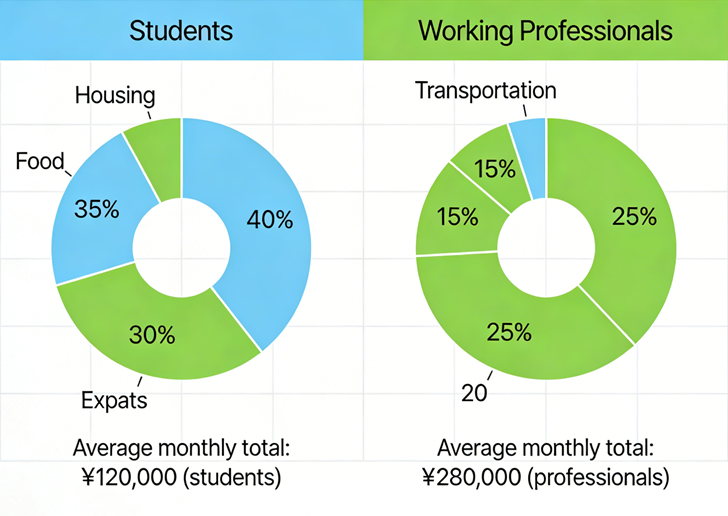
Key Factors Influencing Foreigner Spending in Tokyo
Primary factors affecting foreigner spending in Tokyo: Income level and stability (corporate package vs freelance), Housing choices (expat neighborhood vs local area), Family situation (single vs with children in international schools), Nationality/cultural background (Western vs Asian spending patterns), Length of stay (temporary vs permanent), Language ability (Japanese fluency reduces "foreigner tax"), Company benefits (housing allowance, school tuition coverage), and Personal priorities (saving vs lifestyle enjoyment). Understanding these Tokyo expat spending drivers helps predict and plan your own budget.
Monthly Spending Breakdown by Expense Category
Typical foreigner monthly spending allocation in Tokyo: Housing 30-50% (rent, utilities, insurance), Food 15-25% (groceries, dining out), Transportation 5-10% (commute, travel), Utilities/Communications 5-10% (electricity, gas, water, phone, internet), Healthcare 3-8% (insurance, medical costs), Education 0-30% (tuition, materials - families only), Discretionary 10-20% (entertainment, travel, hobbies), Savings 0-40% (varies by income and goals). Western expats typically allocate 5-15% more to housing and discretionary than Asian expats with similar incomes.
How Foreigner Spending Differs from Japanese Residents
Foreigner vs Japanese spending differences in Tokyo: Foreigners spend 20-50% more on housing (preferring newer buildings, expat areas, larger spaces), 30-100% more on imported foods (shopping at international markets), 50-200% more on education (international schools vs public), 20-40% more on entertainment (Western bars/restaurants vs local options), and 100-300% more on travel home (international flights). Japanese residents typically spend more on savings, insurance, and traditional entertainment. Foreigners often have higher discretionary spending ratios due to temporary mindset and desire to experience Japan.
Foreigner Housing Expenses in Tokyo: Neighborhood Premiums
Foreigner housing expenses in Tokyo represent the largest monthly cost for most expats, with significant premiums paid for expat-friendly neighborhoods, Western-style apartments, and English-speaking services. The Tokyo expat housing premium adds 20-100% to rental costs compared to similar properties in non-expat areas. This section analyzes where foreigners live in Tokyo, what they pay, and why housing consumes 30-50% of most expat budgets in Japan's capital.
Foreigner Housing Costs by Tokyo Neighborhood
| Tokyo Neighborhood | Foreigner % | Studio/1K Rent | 1-Bedroom Rent | 2-Bedroom Rent | Premium vs Local |
|---|---|---|---|---|---|
| Minato (Hiroo, Azabu, Roppongi) | 15-25% | 1,800-3,000 (¥270K-450K JPY) | 2,500-4,500 (¥375K-675K JPY) | 3,500-7,000+ (¥525K-1.05M+ JPY) | 40-60% |
| Shibuya (Daikanyama, Ebisu) | 10-20% | 1,500-2,500 (¥225K-375K JPY) | 2,200-3,800 (¥330K-570K JPY) | 3,200-6,000 (¥480K-900K JPY) | 30-50% |
| Meguro (Nakameguro, Jiyugaoka) | 8-15% | 1,400-2,200 (¥210K-330K JPY) | 2,000-3,500 (¥300K-525K JPY) | 3,000-5,500 (¥450K-825K JPY) | 25-45% |
| Setagaya (Hiroo adjacent, Sangenjaya) | 5-12% | 1,200-2,000 (¥180K-300K JPY) | 1,800-3,000 (¥270K-450K JPY) | 2,500-4,500 (¥375K-675K JPY) | 20-40% |
| Shinjuku (Nishi-Shinjuku, Yoyogi) | 8-18% | 1,300-2,200 (¥195K-330K JPY) | 1,900-3,200 (¥285K-480K JPY) | 2,800-5,000 (¥420K-750K JPY) | 25-45% |
| Chiyoda (Nagatacho, Kojimachi) | 5-10% | 1,600-2,800 (¥240K-420K JPY) | 2,300-4,000 (¥345K-600K JPY) | 3,500-6,500 (¥525K-975K JPY) | 35-55% |
| Non-Expat Areas (Adachi, Katsushika, Edogawa) | 1-3% | 600-1,200 (¥90K-180K JPY) | 900-1,800 (¥135K-270K JPY) | 1,400-2,800 (¥210K-420K JPY) | 0-10% |
Why Foreigners Pay More for Tokyo Housing
Reasons for foreigner housing premium in Tokyo: 1. Expat neighborhood preference (proximity to international schools, embassies, expat services), 2. Newer/Western-style buildings (foreigners prefer modern apartments with Western kitchens, insulation, larger rooms), 3. English-speaking agents/landlords (premium for bilingual services), 4. Less discrimination (some landlords charge foreigners more or only rent through premium agents), 5. Shorter-term mentality (willing to pay more for convenience, less negotiation), 6. Company allowances (corporate housing budgets inflate local prices), 7. Safety/comfort factors (prefer areas with other foreigners, English signage). This Tokyo foreigner housing tax adds thousands to annual housing costs.
Foreigner Housing Choices and Cost Implications
Foreigner housing choices in Tokyo: Corporate housing (20-30% of expats, company pays, premium locations), Expat-focused rentals (40-50%, 20-50% premium, English support), Local market apartments (20-30%, Japanese ability required, normal prices), Share houses (10-20% of single foreigners, cost-effective, social), Monthly mansions (5-10%, flexible, furnished, 10-30% premium), Purchased property (5-10% of long-term foreigners, similar to local prices). Choice dramatically affects Tokyo housing expenditure - expat-focused options cost 20-50% more than integrating into local market.
Salary vs Spending: What Percentage Do Foreigners Spend in Tokyo?
Foreigner salary-to-spending ratios in Tokyo reveal how much of their income different expat groups allocate to living expenses versus savings. From English teachers spending 80-90% of modest salaries to corporate expats saving 20-40% of generous packages, Tokyo expat financial patterns vary dramatically by profession, nationality, and personal priorities. This analysis examines what percentage foreigners actually spend in Tokyo and how much they save or send home.
Foreigner Spending as Percentage of Salary in Tokyo
| Foreigner Group | Average Monthly Salary | Average Monthly Spending | Spending % of Salary | Monthly Savings | Savings % of Salary |
|---|---|---|---|---|---|
| English Teacher (Eikaiwa) | $2,400 (¥360K JPY) | $2,100 (¥315K JPY) | 88% | $300 (¥45K JPY) | 12% |
| English Teacher (ALT/JET) | $2,800 (¥420K JPY) | $2,300 (¥345K JPY) | 82% | $500 (¥75K JPY) | 18% |
| IT Professional (Mid-level) | $4,500 (¥675K JPY) | $3,500 (¥525K JPY) | 78% | $1,000 (¥150K JPY) | 22% |
| Finance Professional | $7,000 (¥1.05M JPY) | $5,000 (¥750K JPY) | 71% | $2,000 (¥300K JPY) | 29% |
| Corporate Expat (With Package) | $8,500* (¥1.28M JPY) | $4,500 (¥675K JPY) | 53%* | $4,000 (¥600K JPY) | 47%* |
| University Student (With Part-time) | $1,200 (¥180K JPY) | $1,800 (¥270K JPY) | 150%* | -$600 (¥-90K JPY) | -50%* |
| Digital Nomad (Freelance) | $4,000 (¥600K JPY) | $3,000 (¥450K JPY) | 75% | $1,000 (¥150K JPY) | 25% |
| Entrepreneur/Self-employed | $5,000 (¥750K JPY) | $3,800 (¥570K JPY) | 76% | $1,200 (¥180K JPY) | 24% |
*Corporate expat salary includes housing allowance, tuition coverage, etc. Student spending exceeds income (supplemented by savings/family support).
Factors Affecting Spending-to-Income Ratios
Key factors influencing foreigner spending ratios in Tokyo: Housing allowances (corporate expats spend lower % of actual income), Family situation (single vs with children in international schools), Nationality expectations (Westerners often maintain home country lifestyle standards), Length of stay (temporary expats spend more, save less), Career trajectory (those viewing Tokyo as stepping stone save more), Home country obligations (sending money home reduces savings), Travel frequency (trips home increase spending 5-20%), Exchange rates (favorable rates increase effective income for some). The Tokyo expat spending ratio typically decreases as income increases.
Savings Patterns Among Foreigners in Tokyo
Foreigner savings patterns in Tokyo: English teachers save 3,000-8,000 annually (12-18% of income), often for travel or next destination. IT professionals save 12,000-30,000 annually (20-30% of income), for investments or future plans. Corporate expats save 30,000-80,000+ annually (30-50% of income), often maximizing retirement accounts. Asian expats typically save 5-15% more than Western expats with similar incomes. Savings destinations: Japanese accounts (40%), home country accounts (35%), investments (20%), cash (5%). Retirement planning: 60% of long-term expats use iDeCo/NISA, 30% use home country plans, 10% no retirement savings.
Foreign Student Spending in Tokyo: Monthly Budget Analysis
Foreign student spending in Tokyo encompasses a wide range from frugal language students to well-funded university scholars. With tuition excluded, monthly student expenses in Tokyo typically range 1,200-2,500, heavily influenced by housing choices, part-time work availability, and lifestyle preferences. This section analyzes how international students allocate their limited budgets in one of the world's most expensive student cities.
Foreign Student Monthly Budget Breakdown in Tokyo
| Expense Category | Language Student (Budget) | Language Student (Comfortable) | University Student (Dorm) | University Student (Apartment) | Graduate Student (Research) |
|---|---|---|---|---|---|
| Housing | $450 (¥67.5K JPY) | $850 (¥127.5K JPY) | $500 (¥75K JPY) | $900 (¥135K JPY) | $800 (¥120K JPY) |
| Food | $280 (¥42K JPY) | $450 (¥67.5K JPY) | $350 (¥52.5K JPY) | $500 (¥75K JPY) | $450 (¥67.5K JPY) |
| Transportation | $80 (¥12K JPY) | $120 (¥18K JPY) | $100 (¥15K JPY) | $150 (¥22.5K JPY) | $120 (¥18K JPY) |
| Utilities | $90 (¥13.5K JPY) | $140 (¥21K JPY) | $110 (¥16.5K JPY) | $160 (¥24K JPY) | $140 (¥21K JPY) |
| Phone/Internet | $50 (¥7.5K JPY) | $80 (¥12K JPY) | $60 (¥9K JPY) | $90 (¥13.5K JPY) | $80 (¥12K JPY) |
| Study Materials | $60 (¥9K JPY) | $100 (¥15K JPY) | $80 (¥12K JPY) | $120 (¥18K JPY) | $150 (¥22.5K JPY) |
| Entertainment/Social | $120 (¥18K JPY) | $300 (¥45K JPY) | $200 (¥30K JPY) | $350 (¥52.5K JPY) | $250 (¥37.5K JPY) |
| Miscellaneous | $70 (¥10.5K JPY) | $160 (¥24K JPY) | $100 (¥15K JPY) | $180 (¥27K JPY) | $150 (¥22.5K JPY) |
| Total Monthly | $1,200 (¥180K JPY) | $2,200 (¥330K JPY) | $1,500 (¥225K JPY) | $2,450 (¥367.5K JPY) | $2,140 (¥321K JPY) |
Student Housing Cost Variations in Tokyo
Foreign student housing costs in Tokyo: University dormitories 300-600/month (subsidized, limited availability, often require early application), Private student dormitories 500-900/month (better facilities, more space), Share houses 450-750/month (social, furnished, utilities included), Monthly mansions 700-1,200/month (private, furnished, short-term), Private apartments 800-1,500+/month (requires guarantor, key money, more paperwork), Homestays 800-1,200/month (meals sometimes included, cultural immersion). Location impact: Dorms often in suburban campuses requiring commute; private housing near stations adds 20-40% cost.
Student Income Sources and Budget Balancing
Foreign student income in Tokyo: Part-time work (up to 28 hours/week, ¥1,000-1,500/hour, 800-1,500/month), Scholarships (MEXT: ¥117,000-242,000/month, JASSO: ¥48,000/month, university scholarships), Family support (500-2,000/month common), Savings from home country (varies widely), Online work (tutoring, freelancing, remote work for home country). Budget balancing: Most students combine 2-3 income sources. Working students typically cover 50-80% of living costs. Scholarship recipients often save 20-50% of stipend. Student financial stress is common, with 60% reporting budget concerns.
Foreign Family Spending in Tokyo: The International School Factor
Foreign family spending in Tokyo escalates dramatically due to international school tuition, larger housing needs, and family-oriented lifestyle costs. The average foreign family in Tokyo spends 4,500-9,000+ monthly, with education representing 25-40% of total expenses. This analysis examines how expat families allocate their substantial Tokyo budgets and the financial impact of raising children in Japan's capital as foreigners.
Foreign Family Monthly Budget Breakdown in Tokyo
| Expense Category | Family of 3 (1 child) | Family of 4 (2 children) | Family of 4 (Corporate Package) | Single Parent + 1 Child | Multinational Family |
|---|---|---|---|---|---|
| Housing (3-4 bedroom) | $2,200 (¥330K JPY) | $2,800 (¥420K JPY) | $1,500* (¥225K JPY) | $1,600 (¥240K JPY) | $2,500 (¥375K JPY) |
| International School (per child) | $2,000 (¥300K JPY) | $4,000 (¥600K JPY) | $0* (company pays) | $2,000 (¥300K JPY) | $3,500 (¥525K JPY) |
| Food/Groceries | $900 (¥135K JPY) | $1,200 (¥180K JPY) | $1,200 (¥180K JPY) | $600 (¥90K JPY) | $1,100 (¥165K JPY) |
| Transportation | $300 (¥45K JPY) | $400 (¥60K JPY) | $500 (¥75K JPY) | $200 (¥30K JPY) | $350 (¥52.5K JPY) |
| Utilities/Communications | $400 (¥60K JPY) | $500 (¥75K JPY) | $500 (¥75K JPY) | $300 (¥45K JPY) | $450 (¥67.5K JPY) |
| Insurance (Health/Life) | $300 (¥45K JPY) | $400 (¥60K JPY) | $200* (company pays part) | $250 (¥37.5K JPY) | $350 (¥52.5K JPY) |
| Child Activities/Lessons | $300 (¥45K JPY) | $500 (¥75K JPY) | $600 (¥90K JPY) | $200 (¥30K JPY) | $400 (¥60K JPY) |
| Family Entertainment/Travel | $500 (¥75K JPY) | $700 (¥105K JPY) | $1,000 (¥150K JPY) | $300 (¥45K JPY) | $600 (¥90K JPY) |
| Miscellaneous | $300 (¥45K JPY) | $400 (¥60K JPY) | $500 (¥75K JPY) | $200 (¥30K JPY) | $350 (¥52.5K JPY) |
| Total Monthly | $7,200 (¥1.08M JPY) | $10,900 (¥1.64M JPY) | $6,000* (¥900K JPY) | $5,650 (¥847.5K JPY) | $9,600 (¥1.44M JPY) |
*Corporate package significantly reduces housing and school costs borne by family.
International School Costs: The Largest Family Expense
International school tuition in Tokyo: American School in Japan 25,000-30,000/year (¥3.75M-4.5M JPY), British School in Tokyo £18,000-£24,000/year (¥3.2M-4.3M JPY), Tokyo International School 22,000-28,000/year (¥3.3M-4.2M JPY), Canadian Academy 20,000-25,000/year (¥3M-3.75M JPY), French School €10,000-€15,000/year (¥1.6M-2.4M JPY). Additional costs: Registration fees 2,000-5,000, building fund 5,000-15,000, uniforms 500-1,000, activities 1,000-3,000, transportation 2,000-4,000. Corporate coverage: 70% of corporate expats have school tuition fully covered, 20% partially covered, 10% self-pay. For self-funded families, school represents 30-50% of total Tokyo expenses.
Family Housing Needs and Costs in Tokyo
Foreign family housing in Tokyo: Size requirements: 3-4 bedrooms, 80-120+ m², Western-style kitchen, multiple bathrooms. Preferred areas: Hiroo, Azabu, Roppongi (near international schools), Denenchofu, Seijo, Yamate (family-friendly, green spaces). Monthly rents: 2,500-5,000+ for suitable family apartments, 4,000-8,000+ for houses. Initial costs: 4-6 months rent upfront (15,000-40,000+). Corporate housing: Often provided or subsidized (up to 5,000-8,000/month allowance). Space premium: Family-sized units cost 2-4x per m² compared to 1-room apartments. Tokyo family housing is the second largest expense after education for most foreign families.
Spending by Industry: How Foreign Professionals Spend in Tokyo
Foreign professional spending in Tokyo varies significantly by industry, with distinct patterns emerging across finance, technology, education, and corporate sectors. These industry-specific spending habits reflect salary differences, workplace cultures, and professional networking norms. This section analyzes how foreigners in different Tokyo industries allocate their incomes and the lifestyle implications of various professional paths in Japan's capital.
Monthly Spending by Industry for Foreign Professionals in Tokyo
| Industry/Profession | Avg. Monthly Salary | Avg. Monthly Spend | Housing % | Entertainment % | Savings % | Distinctive Spending |
|---|---|---|---|---|---|---|
| Finance/Banking | $7,500 (¥1.13M JPY) | $5,200 (¥780K JPY) | 28% | 22% | 31% | Fine dining, luxury goods, golf, networking events |
| Technology/IT | $5,200 (¥780K JPY) | $3,600 (¥540K JPY) | 33% | 18% | 31% | Gadgets, gaming, tech meetups, coworking spaces |
| Corporate Management | $9,000+ (¥1.35M+ JPY) | $5,500 (¥825K JPY) | 25%* | 20% | 39%* | Business class travel, club memberships, concierge services |
| Engineering/Manufacturing | $4,800 (¥720K JPY) | $3,200 (¥480K JPY) | 31% | 16% | 33% | Tools/equipment, professional development, hobby workshops |
| Education (University) | $4,000 (¥600K JPY) | $2,800 (¥420K JPY) | 32% | 15% | 30% | Academic conferences, research materials, book purchases |
| Education (Language Schools) | $2,600 (¥390K JPY) | $2,200 (¥330K JPY) | 36% | 18% | 15% | Travel around Japan, language exchange events, cultural activities |
| Healthcare/Medical | $6,500 (¥975K JPY) | $4,200 (¥630K JPY) | 29% | 17% | 35% | Medical conferences, health club memberships, wellness services |
| Media/Entertainment | $4,500 (¥675K JPY) | $3,500 (¥525K JPY) | 34% | 23% | 22% | Events/shows, equipment, networking drinks, creative spaces |
| Hospitality/Tourism | $3,200 (¥480K JPY) | $2,600 (¥390K JPY) | 35% | 20% | 19% | Industry events, restaurant/bar sampling, travel discounts |
| Legal Services | $8,000 (¥1.2M JPY) | $5,000 (¥750K JPY) | 30% | 19% | 38% | Professional associations, business attire, premium services |
*Corporate management often includes housing allowance, increasing effective savings rate.
Industry-Specific Spending Patterns and Lifestyles
Finance professionals prioritize networking and status, spending heavily on dining, entertainment, and luxury items. IT workers invest in technology and convenience, with higher spending on gadgets, food delivery, and premium subscriptions. Educators focus on cultural experiences and travel, with moderate housing costs and higher discretionary spending on exploration. Corporate managers maintain executive lifestyles with premium services, club memberships, and family-oriented spending. Creative professionals spend on experiences, equipment, and social activities relevant to their fields. Each industry's Tokyo professional spending culture reflects its values, income patterns, and social expectations.
Work-Related Expenses for Foreign Professionals
Foreign professional work expenses in Tokyo: Commuting costs 100-300/month (covered by most employers), Business attire 100-500/month (higher in finance/law), Networking 200-800/month (drinks, meals, events), Professional development 100-500/month (courses, certifications, conferences), Work meals 150-400/month (lunches, dinners with colleagues), Technology 50-300/month (devices, software, subscriptions), Home office 50-200/month (utilities, equipment for remote work). Many companies cover some expenses, but professionals often spend 5-15% of income on career advancement and work-related costs. The Tokyo professional premium is especially high in client-facing industries.
Spending Differences by Nationality in Tokyo
Foreigner spending differences by nationality in Tokyo reveal distinct financial patterns based on cultural backgrounds, home country norms, and adaptation strategies. Western expats typically spend 20-40% more than Asian expats with similar incomes, while spending priorities vary dramatically across national groups. This analysis examines how Americans, Europeans, Asians, and other foreigners allocate their Tokyo budgets differently and the cultural factors driving these spending variations.
Monthly Spending Comparison by Nationality in Tokyo
| Nationality Group | Avg. Monthly Spend | Housing % | Food % | Savings % | Distinctive Spending | Adaptation Style |
|---|---|---|---|---|---|---|
| American | $4,200 (¥630K JPY) | 34% | 18% | 25% | Large apartments, imported foods, fitness, travel | Expat bubble, maintain US lifestyle |
| British | $3,800 (¥570K JPY) | 32% | 17% | 28% | Pubs, travel in Asia, private schools, gardening | Expat community, some local integration |
| French | $3,600 (¥540K JPY) | 30% | 22% | 26% | Wine/cheese imports, fashion, long vacations | French bubble, limited local integration |
| German | $3,400 (¥510K JPY) | 31% | 19% | 30% | Quality products, travel, savings, efficient living | Practical adaptation, value-oriented |
| Chinese | $2,800 (¥420K JPY) | 28% | 20% | 35% | Education, luxury goods, Chinese food, remittances | Chinese community, selective adaptation |
| Korean | $2,700 (¥405K JPY) | 27% | 21% | 33% | Beauty products, K-pop events, Korean food | Korean community, some local integration |
| Indian | $2,500 (¥375K JPY) | 26% | 19% | 38% | Remittances, education, spices/imports, IT gear | Indian community, practical savings focus |
| Australian | $3,500 (¥525K JPY) | 31% | 20% | 27% | Travel, outdoor gear, social drinking, beaches | Expat social, work-life balance focus |
| Brazilian | $2,600 (¥390K JPY) | 30% | 22% | 20% | Social events, Brazilian food, remittances, music | Community-focused, social adaptation |
| Russian | $3,200 (¥480K JPY) | 33% | 18% | 30% | Education, luxury items, travel, cultural events | Expat community, selective local engagement |
Cultural Factors Driving Spending Differences
Cultural factors influencing foreigner spending in Tokyo: Home country cost expectations (Americans expect large spaces, Europeans expect vacation time), Food adaptation (Asians adapt to Japanese food more easily than Westerners), Socializing patterns (Westerners spend more on bars/restaurants, Asians on karaoke/group activities), Family support expectations (Asians more likely to send remittances), Education priorities (Asians spend heavily on tutoring/supplementary education), Savings mentality (Asians save higher percentages, Europeans moderate, Americans variable), Status display (varies by culture - luxury goods, housing, education). These cultural spending patterns in Tokyo persist even after years of residence.
Integration Level vs Spending Patterns
Integration level affects foreigner spending in Tokyo: High integration (live in local neighborhood, speak Japanese, use local services): 20-40% lower spending, especially on housing, food, entertainment. Moderate integration (mixed social circle, basic Japanese, some local services): 10-20% lower spending. Low integration (expat bubble, minimal Japanese, all expat services): 20-40% higher spending. Integration strategies: Learning Japanese saves 5-15% on services, local housing saves 20-40%, local food shopping saves 20-30%, local entertainment saves 30-50%. The Tokyo integration discount is substantial but requires cultural adaptation effort.
Saving vs Spending: Foreigner Financial Strategies in Tokyo
Foreigner saving versus spending strategies in Tokyo reveal diverse approaches to managing finances in Japan's expensive capital. From aggressive savers targeting early retirement to experience-focused spenders maximizing their time abroad, expat financial priorities in Tokyo significantly impact spending patterns, savings rates, and lifestyle choices. This section examines how different foreigners balance saving and spending and the financial strategies employed across the expat community.
Foreigner Saving Rates and Financial Goals in Tokyo
| Foreigner Profile | Typical Savings Rate | Monthly Savings Amount | Primary Savings Goals | Investment Vehicles Used | Financial Challenges |
|---|---|---|---|---|---|
| English Teacher (Early Career) | 10-20% | $200-$500 (¥30K-75K JPY) | Travel, next destination, debt repayment | Home country accounts, cash, occasional stocks | Low salary, visa uncertainty, limited career progression |
| Corporate Expat (Mid-Career) | 30-50% | $2,000-$4,000+ (¥300K-600K+ JPY) | Retirement, children's education, investments | iDeCo, NISA, home country retirement accounts, global investments | Tax complexity, currency risk, dual country obligations |
| IT Professional (High Earner) | 25-40% | $1,500-$3,000 (¥225K-450K JPY) | Early retirement, property purchase, tech investments | Crypto, tech stocks, Japanese ETFs, real estate | Industry volatility, competition, keeping skills current |
| Entrepreneur/Self-Employed | Variable (0-40%) | $0-$3,000 (¥0-450K JPY) | Business reinvestment, emergency fund, retirement | Business assets, personal investments, real estate | Income instability, business risks, lack of corporate benefits |
| Student (With Part-time Work) | 5-15% | $50-$200 (¥7.5K-30K JPY) | Future education, emergency fund, travel | Savings accounts, occasionally home country investments | Limited income, study focus, uncertain post-graduation plans |
| Working Holiday Maker | 10-30% | $200-$600 (¥30K-90K JPY) | Travel continuation, next destination, experiences | Travel fund, savings accounts, minimal investments | Temporary status, job instability, travel expenses |
| Long-Term Resident (Permanent) | 20-35% | $1,000-$2,500 (¥150K-375K JPY) | Retirement in Japan, children's future, property | iDeCo, NISA, Japanese real estate, local investments | Navigating Japanese financial system, language barrier, tax planning |
| Digital Nomad (Remote Worker) | 25-45% | $1,000-$2,500 (¥150K-375K JPY) | Location independence, investment portfolio, early retirement | Global stocks, crypto, online businesses, travel fund | Visa limitations, income verification, unstable residency |
Spending Priorities Among Foreigners in Tokyo
Common spending priorities for foreigners in Tokyo: Experiences over possessions (travel, dining, events), Convenience and time-saving (central location, delivery services, concierge), Health and wellness (gym memberships, healthy food, wellness activities), Education and self-improvement (language lessons, courses, skill development), Social and networking (dining out, events, club memberships), Home comfort (quality housing, Western amenities, familiar foods), Technology (latest gadgets, fast internet, subscriptions). Priorities shift with age, family status, and length of stay. Younger expats prioritize experiences, mid-career focus on family and comfort, older expats on health and legacy.
Financial Challenges Unique to Foreigners in Tokyo
Unique financial challenges for foreigners in Tokyo: Currency exchange risk (income/spending in different currencies), Visa dependency (employment tied to residency, uncertain renewal), Limited credit history (difficulty obtaining loans, mortgages), Double taxation issues (home country and Japanese tax obligations), Retirement planning complexity (multiple country systems, pension coordination), International school costs (if applicable), Travel home expenses (regular flights, gifts, maintaining connections), Expat premium (higher costs for Western-style living), Language barrier in financial matters (complex contracts, investment information), Limited financial product access (some Japanese products require permanent residency/fluency).
Frequently Asked Questions: Foreigner Spending in Tokyo
How much do foreigners spend per month in Tokyo?
Foreigners in Tokyo spend $1,800-$4,500+ (¥270K-675K+ JPY) monthly depending on lifestyle: Students spend $1,200-$2,500, working professionals $2,500-$4,500, families $3,500-$7,000+. Housing is the largest expense at 30-50% of budget. Western expats typically spend 20-40% more than Asian expats due to different lifestyle preferences and housing choices. Corporate expats with packages may have lower personal spending due to company allowances for housing, school, and transportation.
What is the average monthly salary for foreigners in Tokyo?
Average monthly salary for foreigners in Tokyo: English teachers $2,000-$3,000 (¥300K-450K JPY), IT professionals $3,500-$6,500+ (¥525K-975K+ JPY), corporate managers $5,000-$10,000+ (¥750K-1.5M+ JPY), finance professionals $6,000-$12,000+ (¥900K-1.8M+ JPY). Salaries vary by industry, experience, company size, and Japanese language ability. Many expats receive housing allowances reducing personal housing costs. Bonuses can add 1-6 months additional salary annually in some industries.
How much do expats spend on rent in Tokyo?
Expats in Tokyo spend $800-$3,500+ (¥120K-525K+ JPY) monthly on rent: Single professionals $1,200-$2,200, couples $1,500-$2,800, families $2,000-$4,000+. Western expats typically spend 20-40% more on housing than Japanese counterparts for similar properties. Many choose expat-heavy neighborhoods (Hiroo, Azabu, Roppongi) with 30-50% higher rents than average Tokyo areas. Corporate housing allowances often cover 50-100% of rent, reducing personal expenditure for those with packages.
What percentage of salary do foreigners spend in Tokyo?
Foreigners in Tokyo typically spend 60-80% of their salary: 30-50% on housing, 15-25% on food, 5-10% on transportation, 5-10% on utilities/communications, 10-20% on discretionary spending. Higher earners often save 20-40% of income. English teachers and entry-level workers may spend 80-90% of income, while corporate expats with allowances may spend 50-70%. Asian expats typically save 5-15% more of their income than Western expats with similar earnings due to different spending priorities.
How much do foreign students spend monthly in Tokyo?
Foreign students in Tokyo spend $1,200-$2,500 (¥180K-375K JPY) monthly excluding tuition: Housing $500-$1,200, food $300-$600, transportation $80-$150, utilities $100-$200, study materials $50-$150, discretionary $200-$500. Most work part-time (up to 28 hours/week) earning $800-$1,500 monthly. Many choose share houses or student dormitories to reduce costs. Scholarship recipients have lower personal spending. Students from wealthier families may spend significantly more, particularly on housing and entertainment.
How much do foreign families spend in Tokyo?
Foreign families in Tokyo spend $4,500-$9,000+ (¥675K-1.35M+ JPY) monthly: Housing $2,000-$4,000, international school $1,500-$3,000 per child, food $800-$1,500, transportation $300-$600, utilities $400-$700, insurance $300-$600, discretionary $1,000-$2,000. International school tuition is the largest additional expense beyond single/couple costs. Many corporate expat packages cover housing and school costs. Self-funded families must budget carefully, with education often consuming 30-50% of total spending.
What is the most expensive thing for foreigners in Tokyo?
Most expensive costs for foreigners in Tokyo: 1. International school tuition ($1,500-$3,000/month per child), 2. Expat-style housing ($2,000-$4,000+/month), 3. Western food imports (cheese, wine, specialty items at 2-3x home prices), 4. International health insurance ($200-$600/month), 5. Travel home (international flights $800-$2,000+ per trip), 6. Dining at Western restaurants ($50-$150+ per person vs $20-$50 at Japanese restaurants). The "expat premium" adds 20-100% to many regular expenses compared to local alternatives.
How much do English teachers spend in Tokyo?
English teachers in Tokyo spend $1,800-$2,800 (¥270K-420K JPY) monthly from $2,000-$3,200 salaries: Housing $800-$1,500, food $400-$600, transportation $100-$150, utilities $150-$250, phone/internet $80-$120, entertainment $200-$400, savings $200-$500. Many share apartments or live in suburban areas to save. Discretionary spending limited compared to corporate expats. Most save $200-$800 monthly unless supporting family or traveling extensively. JET Programme participants often save more due to higher salaries and rural placements.
How much do IT professionals spend in Tokyo?
IT professionals in Tokyo spend $2,800-$5,000 (¥420K-750K JPY) monthly from $3,500-$6,500+ salaries: Housing $1,200-$2,200, food $500-$800, transportation $150-$250, utilities $200-$350, phone/tech $150-$300, entertainment $400-$800, savings $500-$1,500. Many live in convenient neighborhoods near tech hubs (Shibuya, Shinjuku, Meguro). Higher earners save 20-40% of income. Tech gadgets and subscriptions are significant discretionary expenses. Many invest in crypto, stocks, or side projects beyond regular savings.
Where do foreigners spend the most money in Tokyo?
Foreigners spend most money in Tokyo on: 1. Housing (expat-heavy neighborhoods), 2. International schools, 3. Western restaurants/bars, 4. Imported groceries (foreign food sections), 5. International travel, 6. Fitness/gym memberships (¥8,000-20,000/month), 7. Language lessons (¥5,000-15,000/month), 8. Home country products/services, 9. International shipping, 10. Expat social clubs/memberships. Spending patterns differ significantly from Japanese residents in same income brackets, with more allocated to maintaining home country lifestyles.
How can foreigners save money in Tokyo?
Foreigners save money in Tokyo by: 1. Living like locals (Japanese housing/neighborhoods), 2. Cooking local foods vs imported, 3. Using public transit vs taxis, 4. Shopping at Japanese stores vs import supermarkets, 5. Learning Japanese to access local deals, 6. Choosing Japanese entertainment options, 7. Using local healthcare vs international clinics, 8. Banking with Japanese banks vs international, 9. Avoiding expat premium pricing, 10. Traveling domestically vs internationally. Adopting even a few local habits can save 20-40% compared to full expat lifestyle.
What is the expat premium in Tokyo?
The Tokyo expat premium is 20-100% extra cost for: Housing in expat areas (30-50% more), international schools (2-3x local schools), international supermarkets (30-100% more for imports), Western restaurants (50-100% more than local options), international healthcare (2-3x national insurance), expat services (translation, relocation, tax help), international shipping, travel home. Expats spending locally like Japanese residents can reduce premium significantly. The premium represents both actual cost differences and willingness-to-pay for familiarity and convenience.